
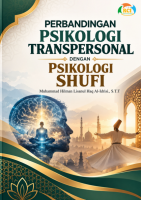
Perbandingan Psikologi Transpersonal Dengan Psikologi Shufi
Synopsis
SPESIFIKASI BUKU
◉ Harga : Rp 185.000
◉ Ukuran : 21 cm x 29 cm
◉ Jumlah Halaman : 220 hal
◉ Ketebalan Buku : 1 cm
◉ ISBN : On Proses
◉ Deskripsi Buku : Manusia modern saat ini hidup di tengah lautan kemajuan teknologi dan kemewahan material yang belum pernah terjadi sebelumnya. Kita dapat terbang melintasi benua dalam hitungan jam, berkomunikasi dengan sesama di belahan bumi lain dalam hitungan detik, dan mengakses seluruh peradaban manusia melalui genggaman tangan. Namun, ironisnya, kemajuan ini justru sering disertai dengan krisis makna (crisis of meaning), kecemasan eksistensial (existential anxiety), dan kekosongan batin (spiritual emptiness) yang mendalam. Psikologi arus utama yang sejak awal didominasi oleh aliran psikoanalisis dan behaviorisme cenderung memandang manusia secara mekanistik atau reduksionis. Aliran-aliran ini sering kali hanya berfokus pada penyembuhan penyakit mental dan patologi, namun mengabaikan potensi tertinggi manusia untuk mencapai kebaikan, kreativitas, dan transendensi. Abraham Maslow, salah satu tokoh kunci psikologi humanistik, menyadari keterbatasan ini. Menjelang akhir hayatnya, ia menegaskan bahwa psikologi humanistik sebagai "kekuatan ketiga" belum cukup untuk memotret kedalaman pengalaman manusia. Ia merasa perlu adanya dimensi yang lebih tinggi, yang ia sebut sebagai "transendensi diri" (self-transcendence), yang kemudian melahirkan psikologi transpersonal sebagai "kekuatan keempat." Di sisi lain, tradisi Islam melalui tasawuf telah mengembangkan peta psikologi spiritual yang sangat rinci selama lebih dari seribu tahun. Konsep-konsep seperti nafs (jiwa/ego), qalb (hati), rūḥ (roh), dan sirr (rahasia ilahi) bukan sekadar istilah teologis, melainkan struktur psike yang menawarkan jalan konkret menuju penyucian jiwa (tazkiyat al-nafs) dan kedekatan dengan Allah
REFERENSI :
Abu-Raiya, H. (2014). Western psychology and Muslim psychology in dialogue: Comparisons between a Qur'anic theory of personality and Freud's and Jung's ideas. Journal of Religion and Health, 53(2), 326–338.
Alcoholics Anonymous World Services. (2001). Alcoholics Anonymous (4th ed.). Alcoholics Anonymous World Services.
Al-Dhufairi, A. A. (2022). Al-mashādir al-dākhiliyyah al-khāṣṣah fī al-talaqqī wa al-istidlāl 'inda al-ṣūfiyyah: Al-'ilm al-ladunī unmūdhajan [Master's thesis, Umm Al-Qura University].
Al-Ghazālī, A. H. (n.d.). Iḥyā' 'ulūm al-dīn. Dār al-Ma'rifah.
Al-Ghazālī, A. H. (1952). Mishkāt al-anwār (W. H. T. Gairdner, Trans.). Sh. Muhammad Ashraf.
Al-Ghazālī, A. H. (2010). The marvels of the heart: Book XXI of The revival of the religious sciences (W. J. Skellie, Trans.). Fons Vitae.
Al-Ghazālī, A. H. (2012). Al-munqidh min al-ḍalāl. Dār al-Kutub al-'Ilmiyyah.
Al-Jīlī, 'A. K. (2004). Al-insān al-kāmil fī ma'rifat al-awākhir wa al-awā'il. Dār al-Kutub al-Islāmiyyah.
Al-Jīlānī, 'A. Q. (2002). Al-fatḥ al-rabbānī. Dār al-Kutub al-'Ilmiyyah.
Al-Qushayrī, 'A. K. (1966). Al-risālah al-qushayriyyah. Dār al-Kutub al-Ḥadīthah.
Al-Qushayrī, 'A. K. (2007). Al-risālah al-qushayriyyah (A. D. Knysh, Trans.). Garnet Publishing.
Al-Sarrāj, A. N. (1914). Kitāb al-luma' fī al-taṣawwuf (R. A. Nicholson, Ed.). Brill.
Al-Sarrāj, A. N. (1960). Al-luma' fī al-taṣawwuf. Dār al-Kutub al-Ḥadīthah.
American Psychiatric Association. (2013). Diagnostic and statistical manual of mental disorders (5th ed.). American Psychiatric Publishing.
Analayo. (2003). Satipaṭṭhāna: The direct path to realization. Windhorse Publications.
Angell, M. (2011). The epidemic of mental illness. The New York Review of Books, 58(11), 23–25.
Angha, H. S. A. N. (1999). Sufism and knowledge. MTO Publications.
Anuruddha. (2012). Abhidhammattha sangaha: A comprehensive manual of Abhidhamma (B. Bodhi, Ed. & Trans.). Buddhist Publication Society.
Arieti, S. (1974). Interpretation of schizophrenia (2nd ed.). Basic Books.
Arrasyid. (2020). Tasawuf dan problematika modernitas: Menimbang maqamat dan ahwal Abu Nashr as-Sarraj. Fuaduna: Jurnal Kajian Keagamaan dan Kemasyarakatan, 4(1), 34–55.
Assagioli, R. (1965). Psychosynthesis: A collection of basic writings. Viking Press.
Assagioli, R. (1973). The act of will. Viking Press.
Assagioli, R. (1993). Psicosintesis: Pedoman bagi pemula (M. M., Trans.). Yayasan Dharma Graha.
Aurobindo, S. (1970). The synthesis of yoga. Sri Aurobindo Ashram.
Aurobindo, S. (1996). The problem of rebirth. Sri Aurobindo Ashram.
Aurobindo, S. (2001). Letters on yoga (Vol. 1). Sri Aurobindo Ashram.
Aurobindo, S. (2005). The life divine. Lotus Press.
Badaruddin, F. H. (2021). Tuhfah al-Mursalah ila Ruh al-Nabiy as the source of the doctrine seven grades of being in the Malay-Indonesian Archipelago. Teosofia, 10(1), 1–25.
Badri, M. (1979). The dilemma of Muslim psychologists. MWH Publishers.
Bair, D. (2003). Jung: A biography. Little, Brown and Company.
Baumeister, R. F., & Leary, M. R. (1995). The need to belong: Desire for interpersonal attachments as a fundamental human motivation. Psychological Bulletin, 117(3), 497–529.
Beck, J. (2011). Cognitive behavior therapy (2nd ed.). Guilford Press.
Bodhi, B. (1994). The noble eightfold path: Way to the end of suffering. Buddhist Publication Society.
Buddhaghosa. (1999). Visuddhimagga: The path of purification (Ñāṇamoli Bhikkhu, Trans.). BPS Pariyatti Editions.
Burns, D. (1999). Feeling good: The new mood therapy. Avon Books.
Campbell, J. D., Trapnell, P. D., Heine, S. J., Katz, I. M., Lavallee, L. F., & Lehman, D. R. (1996). Self-concept clarity: Measurement, personality correlates, and cultural boundaries. Journal of Personality and Social Psychology, 70(1), 141–156.
Cashford, J. (2018). 'Who is my Jung?' The progressive, though sometimes ambivalent, expansion of Jung's idea of the collective unconscious: From an 'unconscious humanity' to—in all but name—the soul of the world. Journal of Analytical Psychology, 63(3), 354–355.
Chittick, W. (1983). The Sufi path of love. SUNY Press.
Chittick, W. (1989). The Sufi path of knowledge: Ibn al-'Arabi's metaphysics of imagination. SUNY Press.
Combs, A. (2009). Consciousness explained better? Paragon House.
Corbin, H. (2005). Alam mitsal dan landasan filosofis irfani (Suharsono, Trans.). Pustaka Pelajar.
Coward, H. (1996). Jung's contribution to transpersonal psychology. Journal of Transpersonal Psychology, 28(2), 101–115.
Crampton, M. (1975). Psychosynthesis: A manual of principles and techniques. Canadian Institute of Psychosynthesis.
Davidson, R., & Lutz, A. (2008). Buddha's brain: Neuroplasticity and meditation. IEEE Signal Processing, 25(1), 171–174.
De Piano, F., et al. (2012). Religious theories of personality and psychotherapy: East meets West. Routledge.
Dumetz, R. (2018). In a dark light: A heuristic investigation of nondual (unitive) experiences [Doctoral dissertation, Pacifica Graduate Institute].
Dupuy, J. (2013). Integral recovery: A revolutionary approach to the treatment of alcoholism and addiction. SUNY Press.
Ernst, C. W. (1985). Words of ecstasy in Sufism. SUNY Press.
Esack, F. (1997). Qur'an, liberation and pluralism. Oneworld.
Esbjörn-Hargens, S. (2010). Integral theory in action. State University of New York Press.
Ferrer, J. (2002). Revisioning transpersonal theory. SUNY Press.
Ferrucci, P. (1982). What we may be: Techniques for psychological and spiritual growth through psychosynthesis. Tarcher/Putnam.
Firman, J., & Gila, A. (2002). Psychosynthesis: A psychology of the spirit. SUNY Press.
Firman, J., & Gila, A. (2011). The psychology of the self: A psychosynthesis perspective. Synthesis Center Press.
Firat, H. (2020). A comparative study of Jungian psychology and Sufism [Doctoral dissertation, University of Essex].
Foucault, M. (1975). Discipline and punish. Gallimard.
Fowler, J. (1981). Stages of faith. Harper & Row.
Frankl, V. (1959). Man's search for meaning. Beacon Press.
Freud, S. (1930). Civilization and its discontents. W. W. Norton.
Gandawijaya, L. E., & Yuniarti, K. W. (2025). Empathic love therapy untuk depresi dan kecemasan pada mahasiswa. Kanal Psikologi UGM.
Geertz, C. (1973). The interpretation of cultures. Basic Books.
Gilbert, P. (2010). Compassion focused therapy. Routledge.
Grof, C. (1995). The thirst for wholeness: Attachment, addiction, and the spiritual path. HarperCollins.
Grof, S. (1975). Realms of the human unconscious: Observations from LSD research. Viking Press.
Grof, S. (1985). Beyond the brain: Birth, death, and transcendence in psychotherapy. SUNY Press.
Grof, S. (1990). The adventure of self-discovery: Dimensions of consciousness and new perspectives in psychotherapy and inner exploration. SUNY Press.
Grof, S. (2000). Psychology of the future: Lessons from modern consciousness research. HarperCollins.
Grof, S., & Grof, C. (Eds.). (1989). Spiritual emergency: When personal transformation becomes a crisis. Tarcher/Putnam.
Grof, S., & Grof, C. (2023). Holotropic breathwork: A new approach to self-exploration and therapy (2nd ed.). SUNY Press.
Gunaratana, B. H. (2011). Mindfulness in plain English. Wisdom Publications.
Hampden-Turner, C. (1971). Radical man. Schenkman.
Hardy, J. (2015). The transpersonal vision of Roberto Assagioli. Transpersonal Psychology Review, 17(1), 12–18.
Havlíková, T., et al. (2022). Holotropic breathwork: Acute and long-term effects on satisfaction with life. Journal of Psychedelic Studies, 6(3), 176–189.
Hayes, S. C. (2004). Acceptance and commitment therapy. Behavior Therapy, 35(4), 639–665.
Hayes, S. C., & Hofmann, S. G. (2018). Process-based CBT. Context Press.
Hayes, S. C., Strosahl, K. D., & Wilson, K. G. (2011). Acceptance and commitment therapy (2nd ed.). Guilford Press.
Heehs, P. (2008). The lives of Sri Aurobindo. Columbia University Press.
Held, B. (2006). Integral theory and its critics. Journal of Humanistic Psychology, 46(1), 50–55.
Hoffman, E. (1988). The right to be human: A biography of Abraham Maslow. Tarcher.
Ibn 'Ajībah. (2007). Īqāẓ al-himam fī sharḥ al-ḥikam. Dār al-Ma'rifah.
Ibn 'Arabī, M. (n.d.). Al-futūḥāt al-makkiyyah (Vols. 1–3). Dār al-Ṣādr.
Ibn 'Arabī, M. (1980). Fuṣūṣ al-ḥikam (A. 'Afīfī, Ed.). Dār al-Kitāb al-'Arabī.
Ibn Kathīr. (1987). Tafsīr al-qur'ān al-'aẓīm (Vols. 1–4). Dār al-Ma'rifah.
Ibn Qayyim al-Jawziyyah. (2000). Risalah fī amrāḍ al-qulūb. Dār al-Kutub al-'Ilmiyyah.
Ibn Qayyim al-Jawziyyah. (2005). Fekah tasawuf: Kaedah-kaedah rawatan penyakit hati (H. a.-R. Hj. Tuskan, Trans.). Darul Fajr.
International Islamic University Malaysia. (2024). Visuddhi and Tazkiyyah: An analysis on purification in the views of Buddhism and Islam [Unpublished master's thesis].
Istifaiyah. (2015). Al-takhalluq bi akhlāq Allāh 'inda 'Abd al-Karīm al-Qushayrī. Teosofia: Indonesian Journal of Islamic Mysticism, 4(2), 110–120.
Izutsu, T. (1964). God and man in the Koran: Semantics of the Koranic Weltanschauung. Keio Institute.
Johnson, R. A. (1986). Inner work: Using dreams and active imagination for personal growth. HarperOne.
Johnson, R. A. (1991). Owning your own shadow: Understanding the dark side of the psyche. HarperOne.
Jung, C. G. (1953). Two essays on analytical psychology (R. F. C. Hull, Trans.; Collected Works, Vol. 7). Princeton University Press.
Jung, C. G. (1959). The archetypes and the collective unconscious (R. F. C. Hull, Trans.; Collected Works, Vol. 9i). Princeton University Press.
Jung, C. G. (1960a). Playboy interview. Playboy Magazine, February 1960, 90.
Jung, C. G. (1960b). The letters of C. G. Jung (Vol. 2). Princeton University Press.
Jung, C. G. (1961). Memories, dreams, reflections. Vintage Books.
Jung, C. G. (1968). Aion: Researches into the phenomenology of the self (R. F. C. Hull, Trans.; Collected Works, Vol. 9ii). Princeton University Press.
Jung, C. G. (1973). Synchronicity: An acausal connecting principle (R. F. C. Hull, Trans.). Princeton University Press.
Published
October 1, 2026
Copyright (c) 2026 Perkumpulan Rumah Cemerlang Indonesia
Details about the available publication format: Pratinjau Buku
Pratinjau Buku
Physical Dimensions
Details about the available publication format: Beli Buku
Beli Buku


