
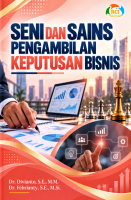
Seni Dan Sains Pengambilan Keputusan Bisnis
Synopsis
SPESIFIKASI BUKU
◉ Harga : Rp 65.000
◉ Ukuran : 15,5 x 23 cm
◉ Jumlah Halaman : 85 hal
◉ Ketebalan Buku : 1 cm
◉ ISBN : On Proses
◉ Deskripsi Buku : Buku ini disusun sebagai upaya untuk memberikan pemahaman yang lebih komprehensif mengenai proses pengambilan keputusan dalam dunia bisnis yang semakin dinamis, kompleks, dan penuh dengan ketidakpastian. Pengambilan keputusan merupakan salah satu aspek penting dalam keberhasilan organisasi dan bisnis. Setiap keputusan yang diambil, baik pada tingkat strategis maupun operasional, dapat memberikan dampak terhadap keberlanjutan, kinerja, daya saing, serta pencapaian tujuan organisasi. Dalam praktiknya, pengambilan keputusan tidak hanya membutuhkan kemampuan untuk menganalisis data dan menggunakan pendekatan ilmiah, tetapi juga memerlukan intuisi, pengalaman, kreativitas, pertimbangan etis, serta kemampuan memahami berbagai kondisi dan perubahan lingkungan bisnis. Oleh karena itu, buku ini mengangkat perspektif seni dan sains secara bersamaan. Sains memberikan landasan melalui data, analisis, metode, model, dan berbagai pendekatan rasional yang dapat membantu menghasilkan keputusan yang lebih terukur. Sementara itu, seni dalam pengambilan keputusan berkaitan dengan kemampuan manusia dalam membaca situasi, mengelola ketidakpastian, mempertimbangkan berbagai kepentingan, menggunakan pengalaman, serta mengambil keputusan secara bijaksana ketika informasi yang tersedia tidak selalu lengkap.
REFERENSI :
Ahuja, S., Chan, Y. E., & Jackson, N. C. (2023). Enterprise resilience in BANI environments: A dynamic capabilities perspective. Journal of Business Research, 158, 113670.
Allspaw, J. (2012). Blameless post-mortems and a just culture. ACM Queue, 10(6), 30–38.
Amason, A. C. (1996). Distinguishing the effects of functional and dysfunctional conflict on strategic decision making: Resolving a paradox for top management teams. Academy of Management Journal, 39(1), 123–148.
Aristotle. (2009). The Nicomachean ethics (D. Ross, Trans.). Oxford University Press.
Arkes, H. R., & Blumer, C. (1985). The psychology of sunk cost. Organizational Behavior and Human Decision Processes, 35(1), 124–140.
Baron, J., & Hershey, J. C. (1988). Outcome bias in decision evaluation. Journal of Personality and Social Psychology, 54(4), 569–579.
Beauchamp, T. L., Bowie, N. E., & Arnold, D. G. (2019). Ethical theory and business (10th ed.). Cengage Learning.
Bennett, N., & Lemoine, G. J. (2014). What VUCA really means for you. Harvard Business Review, 92(1/2), 27.
Brynjolfsson, E., & McAfee, A. (2014). The second machine age: Work, progress, and prosperity in a time of brilliant technologies. W. W. Norton & Company.
Brynjolfsson, E., Li, D., & Raymond, L. (2023). Generative AI at work. National Bureau of Economic Research. Working Paper No. 31161.
Brynjolfsson, E., McElheran, K., & Yuchtman, N. (2021). Data-driven decision making and plant-level productivity: Empirical evidence from US manufacturing. Management Science, 67(8), 4712–4731.
Cascio, J. (2020). Facing the age of chaos. Medium/Institute for the Future.
Chen, M. K., & Sheldon, M. (2016). Dynamic pricing in a labor market: Estimating the supply elasticity of Uber drivers. National Bureau of Economic Research. Working Paper No. 22390.
Chermack, T. J. (2011). Scenario planning in organizations: How to create, use, and assess scenarios. Berrett-Koehler Publishers.
Chouinard, Y. (2016). Let my people go surfing: The education of a reluctant businessman. Penguin Books.
Christensen, C. M. (1997). The innovator's dilemma: When new technologies cause great firms to fail. Harvard Business Review Press.
Clemen, R. T., & Reilly, T. (2013). Making hard decisions with DecisionTools. Cengage Learning.
Dalkey, N., & Helmer, O. (1963). An experimental application of the Delphi method to the use of experts. Management Science, 9(3), 458–467.
Damasio, A. R. (1994). Descartes' error: Emotion, reason, and the human brain. G. P. Putnam's Sons.
Dane, E., & Pratt, M. G. (2007). Exploring intuition and its role in managerial decision making. Academy of Management Review, 32(1), 33–54.
Davenport, T. H. (2018). The AI advantage: How to put the artificial intelligence revolution to work. MIT Press.
Davenport, T. H., & Harris, J. G. (2007). Competing on analytics: The new science of winning. Harvard Business Press.
Davenport, T. H., & Harris, J. G. (2017). Competing on analytics: The new science of winning (2nd ed.). Harvard Business Review Press.
Delbecq, A. L., & Van de Ven, A. H. (1971). A group process model for problem identification and program planning. The Journal of Applied Behavioral Science, 7(4), 466–492.
Dixit, A. K., & Nalebuff, B. J. (1991). Thinking strategically: The competitive edge in business, politics, and everyday life. W. W. Norton & Company.
Doerr, J. (2018). Measure what matters: How Google, Bono, and the Gates Foundation rock the world with OKRs. Portfolio/Penguin.
Eddleston, K. A., Sarstedt, M., & Cooper, A. C. (2019). Dealing with ethical failures: Lessons from the Volkswagen emissions scandal. Business Horizons, 62(1), 65–74.
Edmondson, A. C. (2018). The fearless organization: Creating psychological safety in the workplace for learning, innovation, and growth. John Wiley & Sons.
Eisenhardt, K. M., & Zbaracki, M. J. (1992). Strategic decision making. Strategic Management Journal, 13(S1), 17–37.
Friede, G., Busch, T., & Bassen, A. (2015). ESG and financial performance: Aggregated evidence from more than 2,000 empirical studies. Journal of Sustainable Finance & Investment, 5(4), 210–233.
Garg, S., & Wu, B. (2021). Navigating technological shifts: The strategic evolution of Nvidia. Strategic Management Journal, 42(8), 1450–1478.
Gelman, A., Carlin, J. B., Stern, H. S., Dunson, D. B., Vehtari, A., & Rubin, D. B. (2013). Bayesian data analysis (3rd ed.). CRC Press.
Goleman, D. (2019). Emotional intelligence: Why it can matter more than IQ (25th anniversary ed.). Bantam Books.
Hart, P. ’t. (1991). Irving L. Janis’ victims of groupthink. Political Psychology, 12(2), 247–278.
Hastings, R., & Meyer, E. (2020). No rules rules: Netflix and the culture of reinvention. Penguin Press.
Hertz, D. B. (1964). Risk analysis in capital investment. Harvard Business Review, 42(1), 95–106.
Hodgkinson, G. P., & Healey, M. P. (2011). Psychological foundations of dynamic capabilities: Reflexive and sensing capacities in strategic adaptation. Strategic Management Journal, 32(13), 1500–1516.
Howard, R. A. (1966). Information value theory. IEEE Transactions on Systems Science and Cybernetics, 2(1), 22–26.
Hrebiniak, L. G. (2005). Making strategy work: Leading effective execution and change. Wharton School Publishing.
Iger, B. (2019). The ride of a lifetime: Lessons learned from 15 years as CEO of the Walt Disney Company. Random House.
Janis, I. L. (1972). Victims of groupthink: A psychological study of foreign-policy decisions and fiascoes. Houghton Mifflin.
Janis, I. L. (1982). Groupthink: Psychological studies of policy decisions and fiascoes. Cengage Learning.
Kahneman, D. (2011). Thinking, fast and slow. Farrar, Straus and Giroux.
Kant, I. (1785). Groundwork of the metaphysics of morals (H. J. Paton, Trans., 1948). Harper & Row.
Published
October 1, 2026
Copyright (c) 2026 Perkumpulan Rumah Cemerlang Indonesia
Details about the available publication format: Pratinjau Buku
Pratinjau Buku
Physical Dimensions
Details about the available publication format: Beli Buku
Beli Buku


