
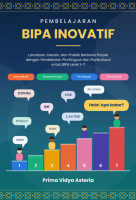
Pembelajaran Bipa Inovatif Landasan, Desain, Dan Praktik Berbasis Proyek Dengan Pendekatan Plurilingual Dan Plurikultural Untuk Bipa Level 1–7
Synopsis
SPESIFIKASI BUKU
Harga : Rp 185.000
Ukuran : 14,8 cm x 21 cm
Jumlah Halaman : 421 hal
Ketebalan Buku : 1 cm
ISBN : On Proses
Deskripsi Buku : Bahasa Indonesia kini dipelajari di banyak negara, di kampus, kedutaan, sekolah internasional, pusat budaya, hingga ruang kelas daring yang mempertemukan pemelajar dari berbagai zona waktu. Pertumbuhan ini membawa harapan sekaligus tuntutan: pembelajaran Bahasa Indonesia bagi Penutur Asing (BIPA) harus dikelola secara profesional, berbasis standar, dan tetap menyenangkan bagi pemelajar yang datang dengan latar bahasa dan budaya yang sangat beragam. Buku Pembelajaran BIPA Inovatif hadir tepat pada kebutuhan itu. Buku ini tidak berhenti pada uraian teori, tetapi menerjemahkan Standar Kompetensi Lulusan (SKL) BIPA menjadi proyek, aktivitas, media, dan asesmen yang bisa langsung dipakai di kelas. Keberanian penulis memadukan pembelajaran berbasis proyek dengan pendekatan plurilingual dan plurikultural menjadikan buku ini relevan dengan arah pendidikan bahasa dunia, sekaligus berakar pada realitas Indonesia yang majemuk. Kami berharap buku ini menjadi rujukan bagi pengajar, calon pengajar, pengelola program, dan peneliti BIPA, serta mendorong lahirnya praktik-praktik baru yang memperkuat peran bahasa Indonesia sebagai bahasa pergaulan internasional.
REFERENSI :
Andajani, K., Pratiwi, Y., Susanto, G., Prastio, B., & Hayeeteh, P. (2024). How is discursive practice on L2 learners conducted? Exploring peace values in environmental conservation texts in textbooks for Indonesian language for foreign speakers. Cogent Education, 11(1), Article 2355824. https://doi.org/10.1080/2331186X.2024.2355824
Bachman, L. F., & Palmer, A. S. (2010). Language assessment in practice. Oxford University Press.
Barrot, J. S. (2023). Using ChatGPT for second language writing: Pitfalls and potentials. Assessing Writing, 57, Article 100745. https://doi.org/10.1016/j.asw.2023.100745
Beacco, J.-C., Byram, M., Cavalli, M., Coste, D., Egli Cuenat, M., Goullier, F., & Panthier, J. (2016). Guide for the development and implementation of curricula for plurilingual and intercultural education. Council of Europe.
Beckett, G. H., & Miller, P. C. (Eds.). (2006). Project-based second and foreign language education: Past, present, and future. Information Age Publishing.
Beckett, G. H., & Slater, T. (2005). The project framework: A tool for language, content, and skills integration. ELT Journal, 59(2), 108–116. https://doi.org/10.1093/eltj/cci024
Black, P., & Wiliam, D. (1998). Assessment and classroom learning. Assessment in Education: Principles, Policy & Practice, 5(1), 7–74. https://doi.org/10.1080/0969595980050102
Blommaert, J. (2010). The sociolinguistics of globalization. Cambridge University Press.
Boud, D., & Molloy, E. (2013). Rethinking models of feedback for learning: The challenge of design. Assessment & Evaluation in Higher Education, 38(6), 698–712. https://doi.org/10.1080/02602938.2012.691462
Brown, H. D., & Abeywickrama, P. (2019). Language assessment: Principles and classroom practices (3rd ed.). Pearson.
Brown, P., & Levinson, S. C. (1987). Politeness: Some universals in language usage. Cambridge University Press.
Bygate, M. (Ed.). (2015). Domains and directions in the development of TBLT: A decade of plenaries from the international conference. John Benjamins.
Byram, M. (1997). Teaching and assessing intercultural communicative competence. Multilingual Matters.
Byram, M. (2021). Teaching and assessing intercultural communicative competence: Revisited (2nd ed.). Multilingual Matters.
Byram, M., & Wagner, M. (2018). Making a difference: Language teaching for intercultural and international dialogue. Foreign Language Annals, 51(1), 140–151. https://doi.org/10.1111/flan.12319
Byram, M., Gribkova, B., & Starkey, H. (2002). Developing the intercultural dimension in language teaching: A practical introduction for teachers. Council of Europe.
Canagarajah, S. (2013). Translingual practice: Global Englishes and cosmopolitan relations. Routledge.
Canale, M., & Swain, M. (1980). Theoretical bases of communicative approaches to second language teaching and testing. Applied Linguistics, 1(1), 1–47. https://doi.org/10.1093/applin/I.1.1
Candelier, M., Daryai-Hansen, P., & Schröder-Sura, A. (2012). The framework of reference for pluralistic approaches to languages and cultures: A complement to the CEFR to develop plurilingual and intercultural competences. Innovation in Language Learning and Teaching, 6(3), 243–257.
Cenoz, J., & Gorter, D. (2021). Pedagogical translanguaging. Cambridge University Press.
Cenoz, J., & Gorter, D. (Eds.). (2015). Multilingual education: Between language learning and translanguaging. Cambridge University Press.
Chapelle, C. A., & Sauro, S. (Eds.). (2017). The handbook of technology and second language teaching and learning. Wiley Blackwell.
Chen, C.-H., & Yang, Y.-C. (2019). Revisiting the effects of project-based learning on students' academic achievement: A meta-analysis investigating moderators. Educational Research Review, 26, 71–81. https://doi.org/10.1016/j.edurev.2018.11.001
Coste, D., Moore, D., & Zarate, G. (2009). Plurilingual and pluricultural competence (Rev. ed.). Council of Europe.
Council of Europe. (2001). Common European framework of reference for languages: Learning, teaching, assessment. Cambridge University Press.
Council of Europe. (2020). Common European framework of reference for languages: Learning, teaching, assessment—Companion volume. Council of Europe Publishing.
Csikszentmihalyi, M. (1990). Flow: The psychology of optimal experience. Harper & Row.
Darvin, R., & Norton, B. (2015). Identity and a model of investment in applied linguistics. Annual Review of Applied Linguistics, 35, 36–56. https://doi.org/10.1017/S0267190514000191
Deardorff, D. K. (2006). Identification and assessment of intercultural competence as a student outcome of internationalization. Journal of Studies in International Education, 10(3), 241–266. https://doi.org/10.1177/1028315306287002
Deci, E. L., & Ryan, R. M. (1985). Intrinsic motivation and self-determination in human behavior. Plenum.
Dehghanzadeh, H., Fardanesh, H., Hatami, J., Talaee, E., & Noroozi, O. (2021). Using gamification to support learning English as a second language: A systematic review. Computer Assisted Language Learning, 34(7), 934–957. https://doi.org/10.1080/09588221.2019.1648298
Deterding, S., Dixon, D., Khaled, R., & Nacke, L. (2011). From game design elements to gamefulness: Defining “gamification.” In Proceedings of the 15th International Academic MindTrek Conference (pp. 9–15). ACM. https://doi.org/10.1145/2181037.2181040
Dewaele, J.-M., & MacIntyre, P. D. (2014). The two faces of Janus? Anxiety and enjoyment in the foreign language classroom. Studies in Second Language Learning and Teaching, 4(2), 237–274. https://doi.org/10.14746/ssllt.2014.4.2.5
Published
September 25, 2026
Copyright (c) 2026 Perkumpulan Rumah Cemerlang Indonesia
Details about the available publication format: Pratinjau Buku
Pratinjau Buku
Physical Dimensions
Details about the available publication format: Beli Buku
Beli Buku


