
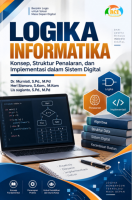
Logika Informatika Dari Penalaran Formal Hingga Rangkaian Digital
Synopsis
SPESIFIKASI BUKU
Harga : Rp 105.000
Ukuran : 14,8 cm x 21 cm
Jumlah Halaman : 215 hal
Ketebalan Buku : 1 cm
ISBN : On Proses
Deskripsi Buku : Buku Logika Informatika ini hadir untuk membantu pembaca melihat logika bukan hanya sebagai kumpulan simbol, tetapi sebagai perangkat penalaran yang menghubungkan bahasa, matematika diskrit, pemrograman, representasi pengetahuan, dan sistem digital. Struktur buku bergerak secara bertahap dari fondasi kebenaran dan validitas menuju proposisi, ekuivalensi, implikasi, inferensi, logika predikat, sistem bilangan, aljabar Boolean, gerbang logika, hingga bentuk kanonik dan minimisasi fungsi Boolean. Kekuatan naskah terletak pada upayanya menjaga hubungan antara konsep formal dan konteks informatika. Tabel kebenaran tidak berhenti sebagai latihan matematis, tetapi dikaitkan dengan kondisi program; aturan inferensi dijembatani menuju sistem berbasis aturan; sistem bilangan dihubungkan dengan representasi data; dan aljabar Boolean dikembangkan menuju rangkaian digital. Pendekatan ini membuat buku dapat digunakan sebagai rujukan konseptual sekaligus pendamping pembelajaran bagi mahasiswa Informatika dan bidang komputasi yang berdekatan. Semoga buku ini mendorong pembaca untuk membangun kebiasaan berpikir yang eksplisit, konsisten, dan dapat diuji. Kritik dan penyempurnaan tetap diperlukan agar buku semakin sesuai dengan kebutuhan pembelajaran serta perkembangan ilmu komputer.
REFERENSI :
Abiteboul, S., Hull, R., & Vianu, V. (1995). Foundations of databases. Addison-Wesley.
Akramunnisa. (2020). Modul pembelajaran logika informatika: Ganjil 2020–2021. Universitas Cokroaminoto Palopo. [Naskah referensi pendukung].
Aristotle. (1984). The complete works of Aristotle: The revised Oxford translation (J. Barnes, Ed.). Princeton University Press.
Ben-Ari, M. (2012). Mathematical logic for computer science (3rd ed.). Springer. https://doi.org/10.1007/978-1-4471-4129-7
Boole, G. (1854). An investigation of the laws of thought. Walton and Maberly.
Brown, S., & Vranesic, Z. (2014). Fundamentals of digital logic with Verilog design (3rd ed.). McGraw-Hill Education.
Bryant, R. E., & O’Hallaron, D. R. (2016). Computer systems: A programmer’s perspective (3rd ed.). Pearson.
Codd, E. F. (1970). A relational model of data for large shared data banks. Communications of the ACM, 13(6), 377–387.
Cormen, T. H., Leiserson, C. E., Rivest, R. L., & Stein, C. (2022). Introduction to algorithms (4th ed.). MIT Press.
Delgrande, J. P., & Lang, J. (2015). Guest editors’ introduction. Journal of Philosophical Logic, 44(2), 111–115. https://doi.org/10.1007/s10992-014-9330-x
Dijkstra, E. W. (1976). A discipline of programming. Prentice-Hall.
Enderton, H. B. (2001). A mathematical introduction to logic (2nd ed.). Academic Press.
Epp, S. S. (2011). Discrete mathematics with applications (4th ed.). Brooks/Cole, Cengage Learning.
Epp, S. S. (2020). Discrete mathematics with applications (5th ed.). Cengage.
Floyd, T. L. (2015). Digital fundamentals (11th ed.). Pearson.
Frege, G. (1879). Begriffsschrift. Louis Nebert.
Genesereth, M. R., & Nilsson, N. J. (1987). Logical foundations of artificial intelligence. Morgan Kaufmann.
Harris, D. M., & Harris, S. L. (2012). Digital design and computer architecture (2nd ed.). Morgan Kaufmann.
Harris, S. L., & Harris, D. M. (2021). Digital design and computer architecture: RISC-V edition. Morgan Kaufmann.
Hoare, C. A. R. (1969). An axiomatic basis for computer programming. Communications of the ACM, 12(10), 576–580. https://doi.org/10.1145/363235.363259
Hurley, P. J., & Watson, L. (2018). A concise introduction to logic (13th ed.). Cengage.
Huth, M., & Ryan, M. (2004). Logic in computer science: Modelling and reasoning about systems (2nd ed.). Cambridge University Press. https://doi.org/10.1017/CBO9780511810275
Karnaugh, M. (1953). The map method for synthesis of combinational logic circuits. Transactions of the American Institute of Electrical Engineers, Part I: Communication and Electronics, 72, 593–599.
Kurose, J. F., & Ross, K. W. (2021). Computer networking: A top-down approach (8th ed.). Pearson.
Law, K. E., Karpudewan, M., & Zaharudin, R. (2021). Computational thinking in STEM education among matriculation science students. Asia Pacific Journal of Educators and Education, 36(1), 177–194. https://doi.org/10.21315/apjee2020.36.1.10
Levin, O. (2021). Discrete mathematics: An open introduction (3rd ed.). School of Mathematical Sciences, University of Northern Colorado.
Levin, O. (2025). Discrete mathematics: An open introduction (4th ed.). [Perlu dilengkapi: verifikasi penerbit/versi sumber yang digunakan].
Limón, Y., Bárcenas, E., & Benítez-Guerrero, E. (2015). Towards a reasoning model for context-aware systems: Modal logic and the tree model property. Research in Computing Science, 99(1), 9–18. https://doi.org/10.13053/rcs-99-1-1
Mano, M. M., & Ciletti, M. D. (2018). Digital design: With an introduction to the Verilog HDL, VHDL, and SystemVerilog (6th ed., Global ed.). Pearson.
McCluskey, E. J., Jr. (1956). Minimization of Boolean functions. Bell System Technical Journal, 35(6), 1417–1444.
Murniati. (n.d.). Ekuivalensi logika: Pertemuan III [Bahan presentasi mata kuliah Logika Informatika]. Program Studi Informatika, Fakultas Teknik Komputer, Universitas Cokroaminoto Palopo.
Murniati. (n.d.). Inferensi logika (validitas argumen) [Bahan presentasi mata kuliah Logika Informatika]. Program Studi Informatika, Fakultas Teknik Komputer, Universitas Cokroaminoto Palopo.
Murniati. (n.d.). Konvers, invers, dan kontraposisi [Bahan presentasi mata kuliah Logika Informatika]. Program Studi Informatika, Fakultas Teknik Komputer, Universitas Cokroaminoto Palopo.
Murniati. (n.d.). Pertemuan IX: Gerbang logika dasar [Bahan presentasi mata kuliah Logika Informatika]. Program Studi Informatika, Universitas Cokroaminoto Palopo.
Quine, W. V. (1952). The problem of simplifying truth functions. The American Mathematical Monthly, 59(8), 521–531.
Rosen, K. H. (2019). Discrete mathematics and its applications (8th ed.). McGraw-Hill Education.
Roth, C. H., Jr., & Kinney, L. L. (2014). Fundamentals of logic design (7th ed.). Cengage Learning.
Russell, B., & Whitehead, A. N. (1910). Principia mathematica (Vol. 1). Cambridge University Press.
Russell, S. J., & Norvig, P. (2021). Artificial intelligence: A modern approach (4th ed.). Pearson.
Shannon, C. E. (1938). A symbolic analysis of relay and switching circuits. Transactions of the American Institute of Electrical Engineers, 57(12), 713–723.
Shute, V. J., Sun, C., & Asbell-Clarke, J. (2017). Demystifying computational thinking. Educational Research Review, 22, 142–158. https://doi.org/10.1016/j.edurev.2017.09.003
Silberschatz, A., Galvin, P. B., & Gagne, G. (2018). Operating system concepts (10th ed.). Wiley.
Stallings, W. (2019). Computer organization and architecture: Designing for performance (11th ed.). Pearson.
Sugianto, L. (n.d.). Aljabar Boolean: Pertemuan IX [Bahan presentasi mata kuliah Logika Informatika]. Program Studi Informatika, Universitas Cokroaminoto Palopo.
Tanenbaum, A. S., & Austin, T. (2013). Structured computer organization (6th ed.). Pearson.
The Unicode Consortium. (2024). The Unicode Standard, Version 16.0. The Unicode Consortium.
Turing, A. M. (1936). On computable numbers, with an application to the Entscheidungsproblem. Proceedings of the London Mathematical Society, 42(1), 230–265. https://doi.org/10.1112/plms/s2-42.1.230
Velleman, D. J. (2019). How to prove it: A structured approach (3rd ed.). Cambridge University Press.
Wakerly, J. F. (2006). Digital design: Principles and practices (4th ed.). Pearson Prentice Hall.
Wing, J. M. (2006). Computational thinking. Communications of the ACM, 49(3), 33–35. https://doi.org/10.1145/1118178.1118215
Yergeau, F. (2003). UTF-8, a transformation format of ISO 10646 (RFC 3629). Internet Engineering Task Force.
Published
September 20, 2026
Copyright (c) 2026 Perkumpulan Rumah Cemerlang Indonesia
Details about the available publication format: Pratinjau Buku
Pratinjau Buku
Physical Dimensions
Details about the available publication format: Beli Buku
Beli Buku


