
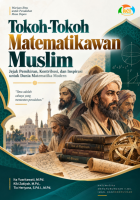
Tokoh-Tokoh Matematikawan Muslim
Synopsis
SPESIFIKASI BUKU
Harga : Rp 85.000
Ukuran : 15,5 cm x 23 cm
Jumlah Halaman : 121 hal
Ketebalan Buku : 1 cm
ISBN : On Proses
Deskripsi Buku : Buku ini lahir dari sebuah keprihatinan sekaligus harapan. Keprihatinan, karena penulis menyadari bahwa banyak generasi muda Muslim hari ini tumbuh tanpa mengenal secara memadai bahwa di balik istilah-istilah matematika yang mereka pelajari setiap hari di bangku sekolah, seperti aljabar, algoritma, dan angka nol, tersimpan sebuah riwayat panjang perjuangan intelektual yang ditempuh oleh para pendahulu mereka sendiri. Harapan, karena penulis meyakini bahwa dengan mengenal kembali riwayat tersebut secara jujur dan berimbang, generasi masa kini dapat menemukan kembali kepercayaan diri intelektualnya: bahwa mencintai ilmu pengetahuan, termasuk matematika yang bagi sebagian orang terasa kering dan menakutkan, sesungguhnya adalah bagian yang tidak terpisahkan dari mencintai dan menghayati ajaran agamanya sendiri. Sebagaimana akan pembaca temukan sepanjang buku ini, Zaman Keemasan Islam bukanlah sebuah era tanpa cela atau tanpa dinamika politik yang rumit. Namun, di tengah gejolak pergantian dinasti dan perebutan kekuasaan itulah justru tumbuh subur sebuah ekosistem keilmuan yang begitu kaya, tempat cendekiawan dari berbagai latar belakang agama dan bangsa, Muslim, Kristen, Yahudi, dan Zoroaster, bekerja bersama menerjemahkan, mendebat, dan mencipta pengetahuan baru.
REFERENSI :
Abdullatif, M. S. A. (2011). Al-Battani contributions in astronomy and mathematics. International Islamic University Malaysia.
Adamson, P. (Ed.). (2005). The Cambridge companion to Arabic philosophy. Cambridge University Press.
Adamson, P. (2007). Al-Kindī. Oxford University Press.
Admin. (2013, May 12). Abu Ja'far Muhammad ibn Musa Al-Khwarizmi. Program Studi Pendidikan Matematika UAD.
Al-Hassan, A. Y., & Hill, D. R. (1986). Islamic technology: An illustrated history. Cambridge University Press.
Al-Khalili, J. (2010). Pathfinders: The golden age of Arabic science. Allen Lane/Penguin Press.
Andrianto, D., et al. (2025). The Qur'an's contribution to the development of mathematics in the history of Islamic civilization. Jazirah: Jurnal Peradaban dan Kebudayaan.
Aydin, N. (2025). Let's teach more accurate and inclusive history! The case of Islamic contributions to mathematics and science. Journal of Humanistic Mathematics, 15(2).
Berggren, J. L. (2016). Episodes in the mathematics of medieval Islam (2nd ed.). Springer.
Brentjes, S. (2018). Teaching and learning the sciences in Islamicate societies, eighth–seventeenth centuries. Brepols.
Burnett, C. (2001). The coherence of the Arabic-Latin translation program in Toledo in the twelfth century. Science in Context, 14(1–2), 249–288.
Burnett, C. (2008). Arabic into Latin: The reception of Arabic philosophy into Western Europe. [Informasi publikasi tidak lengkap].
Dallal, A. (2010). Islam, science, and the challenge of history. Yale University Press.
Encyclopaedia Britannica. (2026, May 22). Al-Khwārizmī. Encyclopaedia Britannica.
Encyclopaedia Britannica. (n.d.). Hindu-Arabic numerals. Encyclopaedia Britannica.
Fauzan, M. A., & Hayat, S. A. (2026). Ilmuwan-ilmuwan Muslim klasik: Pelopor sains modern. Ar-Rasyid: Jurnal Publikasi Penelitian Ilmiah, 2(6), 149–158.
Gandz, S. (1936). The sources of al-Khwarizmi's algebra. Osiris, 1, 263–277.
Gutas, D. (1998). Greek thought, Arabic culture: The Graeco-Arabic translation movement in Baghdad and early 'Abbasid society (2nd–4th/8th–10th centuries). Routledge.
Harisman, Y., & Sania, P. (n.d.). Perkembangan matematika Muslim abad ke-8: Kontribusi Al-Khawarizmi terhadap aljabar. Euclid.
Haskins, C. H. (1927). The renaissance of the twelfth century. Harvard University Press.
Hodgson, M. G. S. (1974). The venture of Islam: Conscience and history in a world civilization (Vols. 1–3). University of Chicago Press.
Hogendijk, J. P. (1986). Thabit ibn Qurra and the pair of amicable numbers 17296, 18416. Historia Mathematica, 13(3), 226–233.
History of Muslim philosophy, Bab 63: Mathematics and astronomy. (n.d.). Dalam Ensiklopedia Islam, entri “Al-Battani.”
Huda, N. (2020). Perkembangan sains dan matematika di wilayah Maghribi pada abad pertengahan. Jurnal Sejarah Peradaban Islam, 3(2), 142–155.
Huff, T. E. (2003). The rise of early modern science: Islam, China, and the West (2nd ed.). Cambridge University Press.
Hughes, B. B. (Ed.). (1986). Gerard of Cremona's translation of al-Khwarizmi's al-Jabr: A critical edition. Mediaeval Studies, 48, 211–263.
Ibn al-Nadim. (1970). The Fihrist of al-Nadim: A tenth-century survey of Muslim culture (B. Dodge, Trans. & Ed.). Columbia University Press. (Original work published 10th century)
Ibn Khallikan. (1843–1871). Ibn Khallikan's biographical dictionary [Wafayat al-A'yan] (M. G. de Slane, Trans.). Oriental Translation Fund. (Original work published 13th century)
Ibrahim, M. (n.d.). Al-Battani contributions in astronomy and mathematics. International Islamic University Malaysia.
Ifrah, G. (2000). The universal history of numbers: From prehistory to the invention of the computer. Wiley.
Ishaq, U. M., & Daud, W. M. N. W. (2017). Tinjauan biografi-bibliografi Ibn al-Haytham. Historia: Jurnal Program Studi Pendidikan Sejarah, 5(2), 107–124.
Ismail, M. R. B. (2016). Algebra in Islamic mathematics. In H. Selin (Ed.), Encyclopaedia of the history of science, technology, and medicine in non-Western cultures. Springer.
Joseph, G. G. (2011). The crest of the peacock: Non-European roots of mathematics (3rd ed.). Princeton University Press.
Kahn, D. (1996). The codebreakers: The comprehensive history of secret communication from ancient times to the internet. Scribner.
Karpinski, L. C. (1914). The algebra of Abu Kamil. The American Mathematical Monthly, 21(2), 37–48.
Karpinski, L. C. (Ed. & Trans.). (1915). Robert of Chester's Latin translation of the algebra of al-Khowarizmi. Macmillan.
Katz, V. J. (2009). A history of mathematics: An introduction (3rd ed.). Pearson.
Kennedy, E. S. (1983). Studies in the Islamic exact sciences. American University of Beirut.
Khairi, A. K. U. (n.d.). Jejak matematika Islam abad pertengahan. Cipta Media Nusantara.
Levey, M. (1966). The algebra of Abu Kamil in a commentary by Mordecai Finzi. University of Wisconsin Press.
Lyons, J. (2009). The house of wisdom: How the Arabs transformed Western civilization. Bloomsbury Press.
Mez, A. (1937). The renaissance of Islam (S. Khuda Bukhsh & D. S. Margoliouth, Trans.). Luzac & Co.
Muhtar, F. (n.d.). Abu Abdullah Ibn Musa Al-Khawarizmi (Pelopor matematika dalam Islam). Beta: Jurnal Tadris Matematika.
Mutmainah, N., Adawiyah, R., Anggraeni, F., & Fatimah, F. N. (2025). The thoughts of Muslim philosopher Al Thusi on Islamic philosophy. Bibliotheca: Journal of Philosophy, 1(2), 53–62.
Nasr, S. H. (1968). Science and civilization in Islam. Harvard University Press.
Neugebauer, O. (1975). A history of ancient mathematical astronomy. Springer.
North, J. D. (1994). The Fontana history of astronomy and cosmology. Fontana Press.
Oaks, J. A. (2014). Al-Khwārizmī and Abū Kāmil on algebra. Aestimatio: Critical Reviews in the History of Science, 4, 1–15.
O'Connor, J. J., & Robertson, E. F. (1999a). Abu Abdallah Mohammad ibn Jabir Al-Battani. MacTutor History of Mathematics Archive, University of St Andrews.
O'Connor, J. J., & Robertson, E. F. (1999b). Abu Ja'far Muhammad ibn Musa Al-Khwarizmi (790–850). MacTutor History of Mathematics Archive, University of St Andrews.
O'Connor, J. J., & Robertson, E. F. (1999c). Abu Kamil Shuja ibn Aslam ibn Muhammad ibn Shuja. MacTutor History of Mathematics Archive, University of St Andrews.
O'Connor, J. J., & Robertson, E. F. (1999d). Abu Yusuf Ya'qub ibn Ishaq al-Sabbah Al-Kindi. MacTutor History of Mathematics Archive, University of St Andrews.
O'Connor, J. J., & Robertson, E. F. (1999e). Al-Karaji (953–1029). MacTutor History of Mathematics Archive, University of St Andrews.
O'Connor, J. J., & Robertson, E. F. (1999f). Al-Sabi Thabit ibn Qurra al-Harrani. MacTutor History of Mathematics Archive, University of St Andrews.
O'Connor, J. J., & Robertson, E. F. (1999g). Al-Samawal (1130–1180). MacTutor History of Mathematics Archive, University of St Andrews.
O'Connor, J. J., & Robertson, E. F. (1999h). Omar Khayyam (1048–1131). MacTutor History of Mathematics Archive, University of St Andrews.
Papadopoulos, A. (2026). Spherical trigonometry before the modern era: The treatise of Nasir al-Din al-Tusi. [Informasi publikasi tidak lengkap].
Parshall, K. H. (1988). The art of algebra from Al-Khwārizmī to Viète: A study in the natural selection of ideas. History of Science, 26(2), 129–164.
Ragep, F. J. (n.d.). The two Raqīds: Al-Battānī and Ibn al-Shāṭir. [Informasi publikasi tidak lengkap].
Rahmawati, L. T., Munjidah, M., Khoirunnisa, F., Sari, P. A. E., & Lailia, S. N. (2021). Matematika dalam era keemasan Islam: Kontribusi Al-Khwarizmi, Al-Biruni, dan Omar Khayyam. Universitas Islam Negeri Sunan Ampel Surabaya.
Rashed, R. (1984). Entre arithmétique et algèbre: Recherches sur l'histoire des mathématiques arabes. Les Belles Lettres.
Rashed, R. (1994). The development of Arabic mathematics: Between arithmetic and algebra (A. Armstrong, Trans.). Kluwer Academic Publishers.
Rashed, R. (Ed.). (1996). Encyclopedia of the history of Arabic science (Vols. 1–3). Routledge.
Rashed, R. (2009a). Al-Khwarizmi: The beginnings of algebra. Saqi Books.
Rashed, R. (Ed.). (2009b). Thabit ibn Qurra: Science and philosophy in ninth-century Baghdad. Walter de Gruyter.
Reskiani, A., & Subhan, R. (2022). Reformulasi Zij Al-Kashi Persia sebagai hisab visibilitas hilal awal bulan Kamariah. Jurnal El-Falaky, 6(1), 85–102.
Ridho, K. A., Fikri, R., & Roza, E. (2026). Mathematics in the era of the Abbasid dynasty: Al-Khawarizmi's contribution to the development of modern mathematical thought in Baghdad 780–850 CE. Batuthah: Jurnal Sejarah Peradaban Islam.
Rosen, F. (Ed. & Trans.). (1831). The algebra of Mohammed ben Musa. Oriental Translation Fund.
Saliba, G. (2007). Islamic science and the making of the European Renaissance. MIT Press.
Saliba, G. (2009). Ṭūsī, Naṣīr al-Dīn II: As mathematician and astronomer. Encyclopaedia Iranica.
Samosir, K., et al. (n.d.). Sejarah perkembangan matematika dalam kebudayaan Arab. Jurnal Review Pendidikan dan Pengajaran.
Sarton, G. (1927). Introduction to the history of science (Vol. 1). Carnegie Institution.
Selin, H. (Ed.). (2000). Mathematics across cultures: The history of non-Western mathematics. Springer.
Sparavigna, A. C. (2019). Al-Biruni and the mathematical geography. International Journal of Sciences, 8(2), 10–22.
Stanford Encyclopedia of Philosophy. (2020). Al-Kindi. Stanford University.
Subagiya, B. (2022). Ilmuwan Muslim polimatik di abad pertengahan. Ta'dibuna: Jurnal Pendidikan Islam, 11(1), 112–125.
Toomer, G. J. (1970a). Al-Battānī. In C. C. Gillispie (Ed.), Dictionary of scientific biography. Charles Scribner's Sons.
Toomer, G. J. (1970b). Al-Khwarizmi. In C. C. Gillispie (Ed.), Dictionary of scientific biography. Charles Scribner's Sons.
Toomer, G. J. (1970c). Thābit ibn Qurra. In C. C. Gillispie (Ed.), Dictionary of scientific biography. Charles Scribner's Sons.
UNESCO. (2015, September 8). Ibn al-Haytham, pioneer of modern optics. UNESCO.
Universitas Ahmad Dahlan. (n.d.). Al-Khawarizmi: Bapak aljabar dan jejaknya dalam peradaban.
Wikipedia. (n.d.). Abū Kāmil. Wikipedia.
Published
September 20, 2026
Copyright (c) 2026 Perkumpulan Rumah Cemerlang Indonesia
Details about the available publication format: Pratinjau Buku
Pratinjau Buku
Physical Dimensions
Details about the available publication format: Beli Buku
Beli Buku


