
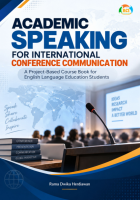
Academic Speaking For International Conference Communication A Project-based Course Book For English Language Education Students
Synopsis
SPESIFIKASI BUKU
Harga : Rp 85.000
Ukuran : 14,8 x 21 cm
Jumlah Halaman : 130 hal
Ketebalan Buku : 1 cm
ISBN : On Proses
Deskripsi : Academic speaking is not merely the ability to speak grammatically. It is the capacity to formulate defensible ideas, organize evidence, communicate disciplinary knowledge, interact ethically with diverse audiences, and respond constructively under real-time pressure. For students of English language education, these competencies support classroom leadership, research dissemination, professional collaboration, and participation in international academic communities. This book translates those competencies into a semester-long project. Across seven chapters, students progress from understanding academic spoken discourse to delivering research-informed presentations, chairing panels, conducting question-and-answer sessions, and managing a conference. The final conference is not an additional activity; it is the central learning environment through which language, academic literacy, teamwork, intercultural communication, and event management are integrated. The design draws on action-oriented language education, project-based learning, genre awareness, reflective practice, and performance assessment. Students are treated as social agents who use English to complete meaningful academic tasks. The lecturer acts as designer, coach, assessor, and quality assurer, while students assume authentic professional roles.
REFERENSI :
Berikut saya rapikan dalam format APA 7th edition, dengan judul buku/jurnal dicetak miring dan pemenggalan baris diperbaiki. Nomor halaman | 118 | dan | 119 | saya hapus karena merupakan nomor halaman dokumen, bukan bagian dari referensi.
Anderson, C. (2016). TED talks: The official TED guide to public speaking. Houghton Mifflin Harcourt.
Basturkmen, H. (2010). Developing courses in English for specific purposes. Palgrave Macmillan.
Brown, H. D., & Abeywickrama, P. (2019). Language assessment: Principles and classroom practices (3rd ed.). Pearson.
Council of Europe. (2020). Common European framework of reference for languages: Learning, teaching, assessment—Companion volume. Council of Europe Publishing.
De Grez, L., Valcke, M., & Roozen, I. (2009). The impact of an innovative instructional intervention on the acquisition of oral presentation skills in higher education. Computers & Education, 53(1), 112–120. https://doi.org/10.1016/j.compedu.2009.01.005
de Jong, N. H., Steinel, M. P., Florijn, A., Schoonen, R., & Hulstijn, J. H. (2013). Linguistic skills and speaking fluency in a second language. Applied Psycholinguistics, 34(5), 893–916. https://doi.org/10.1017/S0142716412000069
Derwing, T. M., & Munro, M. J. (2015). Pronunciation fundamentals: Evidence-based perspectives for L2 teaching and research. John Benjamins. https://doi.org/10.1075/lllt.42
Dörnyei, Z., & Ryan, S. (2015). The psychology of the language learner revisited. Routledge.
Dudley-Evans, T., & St John, M. J. (1998). Developments in English for specific purposes: A multi-disciplinary approach. Cambridge University Press.
Field, J. (2005). Intelligibility and the listener: The role of lexical stress. TESOL Quarterly, 39(3), 399–423. https://doi.org/10.2307/3588487
Goh, C. C. M., & Burns, A. (2012). Teaching speaking: A holistic approach. Cambridge University Press.
Hyland, K. (2009). Academic discourse: English in a global context. Continuum.
Jordan, R. R. (1997). English for academic purposes: A guide and resource book for teachers. Cambridge University Press.
Kang, O., Rubin, D., & Pickering, L. (2010). Suprasegmental measures of accentedness and judgments of language learner proficiency in oral English. The Modern Language Journal, 94(4), 554–566. https://doi.org/10.1111/j.1540-4781.2010.01091.x
Levis, J. M. (2018). Intelligibility, oral communication, and the teaching of pronunciation. Cambridge University Press. https://doi.org/10.1017/9781108241564
Lintner, T., & Belovecová, B. (2024). Demographic predictors of public speaking anxiety among university students. Current Psychology, 43, 25215–25223. https://doi.org/10.1007/s12144-024-06216-w
Lucas, S. E. (2020). The art of public speaking (13th ed.). McGraw-Hill Education.
Mayer, R. E. (2021). Multimedia learning (3rd ed.). Cambridge University Press.
Mercer, N., Hennessy, S., & Warwick, P. (2019). Dialogue, thinking together and digital technology in the classroom: Some educational implications of a continuing line of inquiry. International Journal of Educational Research, 97, 187–199. https://doi.org/10.1016/j.ijer.2017.08.007
Morita, N. (2000). Discourse socialization through oral classroom activities in a TESL graduate program. TESOL Quarterly, 34(2), 279–310. https://doi.org/10.2307/3587953
Nation, I. S. P., & Newton, J. (2009). Teaching ESL/EFL listening and speaking. Routledge.
Piccardo, E., & North, B. (2019). The action-oriented approach: A dynamic vision of language education. Multilingual Matters.
Segalowitz, N. (2010). Cognitive bases of second language fluency. Routledge.
Swales, J. M. (1990). Genre analysis: English in academic and research settings. Cambridge University Press.
Thompson, S. E. (2003). Text-structuring metadiscourse, intonation and the signalling of organisation in academic lectures. Journal of English for Academic Purposes, 2(1), 5–20. https://doi.org/10.1016/S1475-1585(02)00036-X
UNESCO. (2023). Guidance for generative AI in education and research.
van Ginkel, S., Gulikers, J., Biemans, H., & Mulder, M. (2017). Fostering oral presentation performance: Does the quality of feedback differ when provided by the teacher, peers or peers guided by tutor? Assessment & Evaluation in Higher Education, 42(6), 953–966. https://doi.org/10.1080/02602938.2016.1212984
Wallwork, A. (2026). English for presentations at international conferences (3rd ed.). Springer Nature Switzerland. https://doi.org/10.1007/978-3-032-16331-8
Catatan: Saya mempertahankan informasi bibliografis sesuai data yang Anda berikan. Untuk UNESCO (2023), data penerbit/URL belum dicantumkan, sehingga tidak saya tambahkan dengan asumsi.
Published
September 17, 2026
Copyright (c) 2026 Perkumpulan Rumah Cemerlang Indonesia
Details about the available publication format: Pratinjau Buku
Pratinjau Buku
Physical Dimensions
Details about the available publication format: Beli Buku
Beli Buku


