
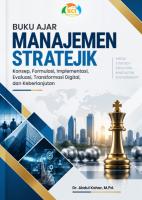
Buku Ajar Manajemen Stratejik Konsep, Formulasi, Implementasi, Evaluasi, Transformasi Digital, dan Keberlanjutan
Synopsis
SPESIFIKASI BUKU
◉ Harga : Rp 165.000
◉ Ukuran : 18 x 25cm
◉ Jumlah Halaman : 368 hal
◉ Ketebalan Buku : 1 cm
◉ ISBN : 978-634-239-413-7
◉ Deskripsi Buku :
Buku ini disusun sebagai salah satu bahan ajar untuk mendukung proses pembelajaran mata kuliah Manajemen Stratejik di perguruan tinggi. Materi yang disajikan mencakup konsep dasar manajemen stratejik, perumusan visi dan misi, analisis lingkungan internal dan eksternal, analisis SWOT, strategi tingkat korporasi, strategi tingkat bisnis, strategi tingkat fungsional, formulasi strategi, implementasi strategi, evaluasi dan pengendalian strategi, hingga pembahasan mengenai transformasi digital, keberlanjutan, dan penerapan manajemen stratejik pada organisasi bisnis maupun sektor publik.
References
Abdurrahman, A., et al. (2024). Impact of dynamic capabilities on digital transformation and innovation. Journal of Open Innovation: Technology, Market, and Complexity, 10(2), 100236.
Bank Rakyat Indonesia. (2018–2024). Laporan tahunan PT Bank Rakyat Indonesia (Persero) Tbk.
Barney, J. B. (1991). Firm resources and sustained competitive advantage. Journal of Management, 17(1), 99–120. https://doi.org/10.1177/014920639101700108
Barney, J. B., & Hesterly, W. S. (2023). Strategic management and competitive advantage (7th ed.). Pearson.
Barney, J. B., Ketchen, D. J., Jr., & Wright, M. (2021). Resource-based theory and the value creation framework. Journal of Management, 47(7), 1936–1955. https://doi.org/10.1177/01492063211021655
Bryson, J. M. (2018). Strategic planning for public and nonprofit organizations: A guide to strengthening and sustaining organizational achievement (5th ed.). Wiley.
Bryson, J. M., & George, B. (2024). Strategic planning for public and nonprofit organizations: A guide to strengthening and sustaining organizational achievement (6th ed.). Wiley.
Chandler, A. D., Jr. (1962). Strategy and structure: Chapters in the history of the American industrial enterprise. MIT Press.
Chen, A., et al. (2024). Digital transformation as the driving force for sustainable business performance. Heliyon, 10, e29518.
David, F. R., & David, F. R. (2023). Strategic management: A competitive advantage approach, concepts and cases. Pearson.
David, F. R., David, F. R., & David, M. E. (2020). Strategic management: A competitive advantage approach, concepts and cases (17th ed.). Pearson.
Dess, G. G., McNamara, G., Eisner, A. B., & Sauerwald, S. (2024). Strategic management: Creating competitive advantages (11th ed.). McGraw-Hill Education.
D'Oria, L., Crook, T. R., Ketchen, D. J., Jr., Sirmon, D. G., & Wright, M. (2021). The evolution of resource-based inquiry: A review and meta-analytic integration of the strategic resources-actions-performance pathway. Journal of Management, 47(6), 1383–1429. https://doi.org/10.1177/0149206321994182
Drucker, P. F. (1974). Management: Tasks, responsibilities, practices. Harper & Row.
Dyer, J. H., Godfrey, P., Jensen, R., & Bryce, D. (2024). Strategic management: Concepts and cases (5th ed.). Wiley.
Eisenhardt, K. M., & Martin, J. A. (2000). Dynamic capabilities: What are they? Strategic Management Journal, 21(10–11), 1105–1121.
Feliciano-Cestero, M. M., et al. (2023). Is digital transformation threatened? A systematic literature review of the factors influencing firms' digital transformation and internationalization. Journal of Business Research, 157, 113546.
Galbraith, J. R. (2014). Designing complex organizations. Jossey-Bass.
Grant, R. M. (1991). The resource-based theory of competitive advantage: Implications for strategy formulation. California Management Review, 33(3), 114–135.
Grant, R. M. (2021). Contemporary strategy analysis (11th ed.). Wiley-Blackwell.
Guandalini, I. (2022). Sustainability through digital transformation: A systematic literature review. Journal of Business Research, 148, 456–471.
Hafeez, S., et al. (2025). Knowledge management and SMEs' digital transformation. Journal of Innovation & Knowledge, 10, 100650.
Hambrick, D. C., & Mason, P. A. (1984). Upper echelons: The organization as a reflection of its top managers. Academy of Management Review, 9(2), 193–206.
Hill, C. W. L., Schilling, M. A., & Jones, G. R. (2023). Strategic management: Theory and cases: An integrated approach (14th ed.). Cengage Learning.
Hrebiniak, L. G. (2006). Making strategy work: Leading effective execution and change. Wharton School Publishing.
Johnson, G., Whittington, R., Scholes, K., Angwin, D., & Regnér, P. (2020). Exploring strategy (12th ed.). Pearson.
Kaplan, R. S., & Norton, D. P. (2005). The balanced scorecard: Measures that drive performance. Harvard Business Review, 70, 71–79.
Kim, W. C., & Mauborgne, R. (2015). Blue ocean strategy: How to create uncontested market space and make the competition irrelevant. Harvard Business Review Press.
Kim, W. C., & Mauborgne, R. (2024). Beyond disruption: Innovate and achieve growth without displacing incumbents. Harvard Business Review Press.
Kitsios, F., & Kamariotou, M. (2022). Strategic management and digital transformation: A systematic literature review. Sustainability, 14(3), 1755.
Kotler, P., & Keller, K. L. (2024). Marketing management (18th ed.). Pearson.
Kotter, J. P. (2012). Leading change. Harvard Business Review Press.
Kraus, S., et al. (2022). Digital transformation in business and management research: An overview of the current status quo. International Journal of Information Management, 63, 102466.
Published
September 14, 2026
Copyright (c) 2026 Perkumpulan Rumah Cemerlang Indonesia
Details about the available publication format: Pratinjau Buku
Pratinjau Buku
Physical Dimensions
Details about the available publication format: Beli Buku
Beli Buku


