
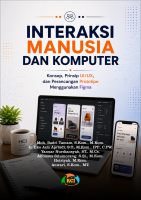
Interaksi Manusia dan Komputer: Konsep, Prinsip UI/UX, dan Perancangan Prototipe Menggunakan Figma
Synopsis
SPESIFIKASI BUKU
Harga : Rp 125.000
Ukuran : 14,8 x 21 cm
Jumlah Halaman : 253 hal
Ketebalan Buku : 2 cm
ISBN : 978-634-239-549-3
Deskripsi : Puji syukur kami panjatkan kehadirat Allah Subhanahu wa Ta'ala, karena berkat limpahan karunia-Nya, penulis dapat menyelesaikan penulisan buku yang berjudul “INTERAKSI MANUSIA DAN KOMPUTER Konsep, Prinsip UI/UX, dan Perancangan Prototipe Menggunakan Figma” Di dalam penyusunan buku ini penulis telah berusaha semaksimal mungkin sesuai dengan kemampuan penulis. Tetapi sebagai manusia biasa, penulis tak luput dari kesalahan ataupun kekhilafan baik pada segi teknik penulisan ataupun tata bahasa itu sendiri. Buku ini diharapkan buku ini dapat menambah khazanah ilmu di Indonesia. Buku ini dapat tersusun dengan baik karena bantuan berbagai pihak.Penulis juga mengharap kritik dan saran yang membangun untuk buku ini kedepannya. Penulis sangat menyadari bahwa buku ini masih banyak kekurangan baik pada tata cara penulisan, serta substansinya yang masih jauh dari kesempurnaan. Semoga buku ini dapat bermanfaat nantinya. Buku ini disusun sebagai bahan referensi pembelajaran mata kuliah Interaksi Manusia dan Komputer (IMK), dengan fokus pada penerapan praktis konsep UI/UX design melalui perangkat lunak Figma. Berbeda dengan buku ajar konvensional yang cenderung teoritis, buku ini menekankan keseimbangan antara pemahaman konsep fundamental dan kemampuan praktik langsung (hands-on), sehingga pembaca tidak hanya memahami 'mengapa' suatu prinsip diterapkan, tetapi juga 'bagaimana' cara menerapkannya secara nyata.
References
Brooke, J. (1996). SUS: A Quick and Dirty Usability Scale. Usability Evaluation in Industry, 189(194), 4–7.
Buxton, B. (2010). Sketching User Experiences: Getting the Design Right and the Right Design. Morgan Kaufmann.
Cooper, A. (1999). The Inmates Are Running the Asylum: Why High-Tech Products Drive Us Crazy and How to Restore the Sanity. Sams Publishing.
Cooper, A., Reimann, R., Cronin, D., & Noessel, C. (2014). About Face: The Essentials of Interaction Design (4th ed.). Wiley.
Figma, Inc. (2024). Figma Help Center & Documentation. Diakses dari https://help.figma.com
Figma, Inc. (2025). Figma Best Practices & Community Resources. Diakses dari https://www.figma.com/best-practices/
Garrett, J. J. (2011). The Elements of User Experience: User-Centered Design for the Web and Beyond (2nd ed.). New Riders.
International Organization for StKitardization. (2019). ISO 9241-210: Ergonomics of Human-System Interaction Human-Centred Design for Interactive Systems.
Kalbach, J. (2016). Mapping Experiences: A Complete Guide to Creating Value through Journeys, Blueprints, and Diagrams. O'Reilly Media.
Krug, S. (2014). Don't Make Me Think, Revisited: A Common Sense Approach to Web Usability (3rd ed.). New Riders.
Miller, G. A. (1956). The Magical Number Seven, Plus or Minus Two: Some Limits on Our Capacity for Processing Information. Psychological Review, 63(2), 81–97.
Nielsen, J. (1993). Usability Engineering. Academic Press.
Norman, D. A. (2013). The Design of Everyday Things: Revised and Expanded Edition. Basic Books.
Preece, J., Rogers, Y., & Sharp, H. (2015). Interaction Design: Beyond Human-Computer Interaction (4th ed.). Wiley.
Tidwell, J. (2020). Designing Interfaces: Patterns for Effective Interaction Design (3rd ed.). O'Reilly Media.
World Wide Web Consortium. (2018). Web Content Accessibility Guidelines (WCAG) 2.1. Diakses dari https://www.w3.org/TR/WCAG21/
Published
October 1, 2026
Copyright (c) 2026 Perkumpulan Rumah Cemerlang Indonesia
Details about the available publication format: Pratinjau Buku
Pratinjau Buku
Physical Dimensions
Details about the available publication format: Beli Buku
Beli Buku


