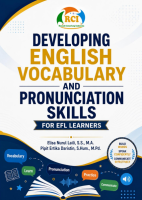
Developing English Vocabulary And Pronunciation Skills For Efl Learners
Synopsis
SPESIFIKASI BUKU
Harga : Rp 65.000
Ukuran : 18 cm x 25 cm
Jumlah Halaman : 101 hal
Ketebalan Buku : 1 cm
ISBN : On Proses
Deskripsi Buku : Vocabulary plays a fundamental role in language learning. A sufficient range of vocabulary enables learners to understand spoken and written texts, express ideas, participate in conversations, and communicate more effectively. Without adequate vocabulary knowledge, learners may experience difficulties in developing their listening, speaking, reading, and writing skills. Therefore, systematic and contextual vocabulary development is an important part of the English language learning process. Pronunciation is equally important in effective communication. Having a broad vocabulary alone is not sufficient if learners experience difficulty pronouncing words clearly and accurately. Appropriate pronunciation helps learners communicate their ideas more confidently, reduces misunderstandings, and improves their ability to participate in spoken interactions. For EFL learners, mastering English pronunciation can be particularly challenging because of differences between the sound systems, stress patterns, rhythms, and intonation of English and their first language. This book is designed to integrate vocabulary development and pronunciation practice into a practical and meaningful learning process. Rather than treating vocabulary and pronunciation as separate areas of study, the book encourages learners to understand new words, recognize their meanings and contexts of use, and develop the ability to pronounce them appropriately. Through this integrated approach, learners are expected to develop stronger connections between word knowledge and oral communication skills.
REFERENSI :
Boers, F. (2021). Evaluating second language vocabulary and grammar instruction: A synthesis of the research on teaching words, phrases and patterns. Routledge.
Coady, J., & Huckin, T. (Eds.). (2012). Second language vocabulary acquisition. Cambridge University Press.
Coxhead, A. (2018). Vocabulary and English for specific purposes research: Quantitative and qualitative perspectives. In The Routledge Handbook of Vocabulary Studies (pp. 1–15). Routledge.
Derwing, T. M., & Munro, M. J. (2015). Pronunciation fundamentals: Evidence-based perspectives for L2 teaching and research. John Benjamins.
Ellis, N. C., Römer, U., & O’Donnell, M. B. (2016). Usage-based approaches to language acquisition and processing. Wiley-Blackwell.
Eniati, N. K., & Numertayasa, I. W. (2023). Analisis kesulitan pengucapan kosakata Bahasa Inggris siswa sekolah dasar. NUSRA: Jurnal Penelitian dan Ilmu Pendidikan.
Granger, S., & Paquot, M. (Eds.). (2021). The Routledge handbook of vocabulary studies (2nd ed.). Routledge.
Handayani, E. (2023). Penguasaan kosa kata Bahasa Inggris peserta didik di sekolah dasar. Karimah Tauhid.
Ihsan, A. I. (2025). Teaching vocabulary in Indonesian EFL classrooms: Strategies, challenges, and student responses. GLOBAL: Education Language and Humanity Journal.
Kenworthy, J. (1987). Teaching English pronunciation. Longman.
Laufer, B., & Ravenhorst-Kalovski, G. C. (2010). Lexical threshold revisited: Lexical text coverage, learners’ vocabulary size, and reading comprehension. Reading in a Foreign Language, 22(1), 15–30.
Laufer, B. (2013). Vocabulary acquisition and teaching strategy use: A psycholinguistic perspective. Language Learning Journal, 41(3), 267–280.
Levis, J. M. (2018). Intelligibility, oral communication, and the teaching of pronunciation. Cambridge University Press.
Levis, J. M. (2020). Revisiting the intelligibility and nativeness principles. Journal of Second Language Pronunciation, 6(3), 1–19.
Lewis, M. (1997). Implementing the lexical approach: Putting theory into practice. Heinle.
Lewis, M. (2008). The lexical approach: The state of ELT and a way forward. Heinle.
Meara, P. (2014). Connected language learning: Towards a research agenda for vocabulary. Language Teaching, 47(4), 529–536.
Nation, I. S. P., & Waring, R. (2013). Teaching vocabulary: Lessons from the research. Language Teaching, 46(1), 97–116.
Nation, I. S. P. (2022). Learning vocabulary in another language (2nd ed.). Cambridge University Press.
Pellicer-Sánchez, A., & Schmitt, N. (Eds.). (2018). Researching vocabulary in another language. Palgrave Macmillan.
Pennington, M. C., & Rogerson-Revell, P. (2019). English pronunciation teaching and research: Contemporary perspectives. Palgrave Macmillan.
Rianugraha, Y. (2025). Collocational competence among Indonesian EFL learners: Types of errors, causes, and pedagogical implications. Lingua: Jurnal Ilmiah, 21(2).
Roach, P. (2015). English phonetics and phonology glossary. Cambridge University Press.
Roach, P. (2019). English phonetics and phonology: A practical course (5th ed.). Cambridge University Press.
Schmitt, N. (2010). Researching vocabulary: A vocabulary research manual. Palgrave Macmillan.
Schmitt, N., & Schmitt, D. (2012). New ways of teaching vocabulary. TESOL Quarterly, 46(1), 83–108.
Schmitt, N., & Schmitt, D. (2020). Vocabulary in language teaching. In The Routledge Handbook of English Language Teaching (pp. 203–218). Routledge.
Thomson, R. I., & Derwing, T. M. (2019). The effectiveness of L2 pronunciation instruction: A narrative review. Language Teaching Research, 23(3), 1–25.
Wardana, I. K., Astuti, P. T., & Sukanadi, N. L. (2021). Examining the effect of phonological awareness instruction on EFL learners’ pronunciation and motivation. Erudita: Journal of English Language Teaching.
Webb, S. (2010). Teaching vocabulary. The Canadian Modern Language Review / La Revue Canadienne des Langues Vivantes, 66(1), 4–14.
Webb, S., & Nation, I. S. P. (2017). How vocabulary is learned. Oxford University Press.