
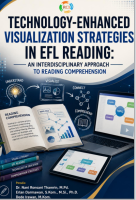
Technology-enhanced Visualization Strategies In Efl Reading: An Interdisciplinary Approach To Reading Comprehension
Synopsis
SPESIFIKASI BUKU
Harga : Rp 65.000
Ukuran : 15,5 cm x 23 cm
Jumlah Halaman : 96 hal
Ketebalan Buku : 1 cm
ISBN : On Proses
Deskripsi Buku : The rapid advancement of digital technology has transformed educational practices across the globe, reshaping the ways learners access, process, and construct knowledge. In the field of English as a Foreign Language (EFL) education, these developments have created new opportunities for enhancing reading instruction through innovative, technology-supported pedagogical approaches. Among these approaches, visualization strategies have emerged as a promising means of facilitating reading comprehension by enabling learners to construct meaningful mental and visual representations of textual information. This book, entitled Technology-Enhanced Visualization Strategies in EFL Reading: An Interdisciplinary Approach to Reading Comprehension, is the result of an interdisciplinary collaboration among scholars in English language education, computer science, and information systems. It reflects our shared commitment to exploring how technological innovations can enrich language learning experiences and address the evolving needs of learners in the digital era.
REFERENSI ;
Aizawa, I., Rose, H., Thompson, G., & Curle, S. (2023). Beyond the threshold: Exploring English language proficiency, linguistic challenges, and academic language skills of Japanese students in an English medium instruction programme. Language Teaching Research, 27(4), 837–861. https://doi.org/10.1177/13621688211009511
Anderson, R. C. (2018). Role of the reader’s schema in comprehension, learning, and memory. In D. E. Alvermann, N. J. Unrau, M. Sailors, & R. B. Ruddell (Eds.), Theoretical models and processes of literacy (7th ed., pp. 136–145). International Literacy Association.
Arikunto, S. (2021). Penelitian tindakan kelas (Rev. ed.). Bumi Aksara.
Asnawi, A., Sinaga, Y. K., Herman, H., Sianturi, B. K., Kartolo, R., & Tannuary, A. (2025). Investigating teaching-learning strategies in improving EFL learners’ reading comprehension: A lesson learned from junior high schools. Journal of Languages and Language Teaching, 13(1), 189–202. https://doi.org/10.33394/jollt.v13i1.13348
Belda-Medina, J. (2022). Promoting inclusiveness, creativity and critical thinking through digital storytelling among EFL teacher candidates. International Journal of Inclusive Education, 26(2), 109–123. https://doi.org/10.1080/13603116.2020.1813450
Brown, H. D. (2019). Principles of language learning and teaching (6th ed.). Pearson Education.
Cremin, T. (2022). Teaching English creatively (2nd ed.). Routledge.
Damiri, A., Hastomo, T., & Sari, Y. A. (2022). Visualization strategy: An effective strategy to teach reading to middle school students. SELTICS: Scope of English Language Teaching, Literature and Linguistics, 5(1), 1–8. https://doi.org/10.46918/seltics.v5i1.1452
Djuhartono, T., Wibowo, P. A., & Haryanto, H. (2023). Class action research workshop with participant active learning for educators. ABDIMAS: Jurnal Pengabdian Masyarakat, 6(4), 4387–4400.
Firat, E. E., Joshi, A., & Laramee, R. S. (2022). Interactive visualization literacy: The state-of-the-art. Information Visualization, 21(3), 285–310. https://doi.org/10.1177/14738716211019405
Guntur, M., Gani, H. A., & Mustafa, M. (2021). The impacts of content and language integrated learning (CLIL) method on university students’ reading comprehension skills in Indonesia. Journal of Language Teaching and Research, 12(5), 794–802. https://doi.org/10.17507/jltr.1205.14
Hazaymeh, W., & Alomery, M. K. (2022). The effectiveness of visual mind mapping strategy for improving English language learners’ critical thinking skills and reading ability. European Journal of Educational Research, 11(1), 141–150. https://doi.org/10.12973/eu-jer.11.1.141
Kim, H.-C., & Hyun, M. Y. (2016). Predicting the use of smartphone-based augmented reality (AR): Does telepresence really help? Computers in Human Behavior, 59, 28–38. https://doi.org/10.1016/j.chb.2016.01.039
Kress, G. (2019). Multimodality: A social semiotic approach to contemporary communication (2nd ed.). Routledge.
Mayer, R. E. (2020). Multimedia learning (3rd ed.). Cambridge University Press.
Mugabekazi, J. C., Mukanziza, J., Nizeyimana, P., & Manirahari, P. (2025). Integrating collaborative learning strategies in the curriculum: Enhancing critical thinking and communication skills in primary education. European Journal of Education Studies, 12(3), 233–248.
OECD. (2021). 21st-century readers: Developing literacy skills in a digital world. OECD Publishing. https://doi.org/10.1787/a83d84cb-en
Paivio, A. (2014). Mind and its evolution: A dual coding theoretical approach. Psychology Press.
Putri, Y. D., Dewi, K., & Amir, H. (2023). Upaya meningkatkan hasil belajar melalui model problem-based learning. In Prosiding Seminar Nasional Pendidikan (pp. 245–252).
Qin, X. (2024). Collaborative inquiry in action: A case study of lesson study for intercultural education. Asian-Pacific Journal of Second and Foreign Language Education, 9(1), Article 66. https://doi.org/10.1186/s40862-024-00235-4
Rumelhart, D. E. (1980). Schemata: The building blocks of cognition. In R. J. Spiro, B. C. Bruce, & W. F. Brewer (Eds.), Theoretical issues in reading comprehension (pp. 33–58). Lawrence Erlbaum Associates.
Santi, M., & Reflinda, R. (2022). Using visualization strategy to improve students’ reading skill in comprehending detailed information. Modality Journal: International Journal of Linguistics and Literature, 2(1), 24–35.
Sihombing, M., & Napitupulu, S. (2025). Enhancing English writing skill through active reading. Innovative: Journal of Social Science Research, 5(1), 1428–1440.
Šliogerienė, J., Darginavičienė, I., Suchanova, J., Gulbinskienė, D., & Jakučionytė, V. (2025). Problem-based learning in developing students’ communicative skills and creativity. Creativity Studies, 18(1), 30–42. https://doi.org/10.3846/cs.2025.22508
Stambaugh, T., Covington, E., & Mofield, E. L. (2025). Crafting expertise: Developing talent in English language arts. Gifted Child Quarterly. Advance online publication. https://doi.org/10.1177/00169862251315876
Sweller, J. (2019). Cognitive load theory and educational technology. Educational Psychology Review, 31(2), 261–292. https://doi.org/10.1007/s10648-019-09465-5
Thamrin, N. R., Darmawan, E., & Irawan, D. (2025). Enhancing reading skills through visualizing strategies: A fresh approach for English education students at Kuningan University. Jurnal Pendidikan Bahasa Inggris Undiksha, 13(1), 48–58.
Wahyuni, S. (2021). Improving students’ reading comprehension by using folktale: Classroom action research. Journal of English Language and Pedagogy, 1(1), 49–59.
Yapp, D., de Graaff, R., & van den Bergh, H. (2023). Effects of reading strategy instruction in English as a second language. Language Teaching Research, 27(6), 1456–1479. https://doi.org/10.1177/13621688211019464
Yulian, R. (2021). The flipped classroom: Improving critical thinking for critical reading of EFL learners. Studies in English Language and Education, 8(2), 508–522. https://doi.org/10.24815/siele.v8i2.18379
Published
July 2, 2026
Copyright (c) 2026 Perkumpulan Rumah Cemerlang Indonesia
Details about the available publication format: Pratinjau Buku
Pratinjau Buku
Physical Dimensions
Details about the available publication format: Beli Buku
Beli Buku


