
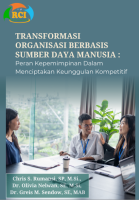
Transformasi Organisasi Berbasis Sumber Daya Manusia : Peran Kepemimpinan Dalam Menciptakan Keunggulan Kompetitif
Synopsis
SPESIFIKASI BUKU
Harga : Rp 85.000
Ukuran : 18 x 25 cm
Jumlah Halaman : 119 hal
Ketebalan Buku : 2 cm
ISBN : On Proses
Deskripsi Buku : Buku dengan judul “Transformasi Organisasi Berbasis Sumber Daya Manusia: Peran Kepemimpinan dalam Menciptakan Keunggulan Kompetitif” dapat selesai sesuai dengan yang ditargetkan. Buku ini berisikan pembahasan mengenai konsep dasar sumber daya manusia, peran strategis SDM dalam organisasi, kepemimpinan modern, serta transformasi organisasi dalam menghadapi era globalisasi dan digitalisasi. Selain itu, buku ini juga mengkaji bagaimana kepemimpinan yang efektif dan pengelolaan SDM yang strategis dapat menjadi kunci dalam menciptakan keunggulan kompetitif yang berkelanjutan bagi organisasi . Kami menyadari bahwa buku ini masih jauh dari sempurna, oleh karena itu kritik dan saran dari semua pihak yang bersifat membangun selalu kami harapkan demi kesempurnaan buku ini.
REFERENSI :
Aguinis, H. (2019). Performance Management (4th ed.).
https://vulms.vu.edu.pk/Courses/HRM713/Downloads/Performance%20Management%203rd%20Edition%20by%20Aguinis.pdf
Ahmad Jawad, Zafar, M. R., & Khan, M. M. A. (2024). Investigating the role of strategic human resource management, leadership styles, and organizational culture in enhancing organizational performance.
https://www.jhhss.com/index.php/jhhss/article/view/24
Alatawna, S. M. M., & Abbas, A. D. (2025). Strategic role of human resource management in university decision-making: Evidence from Northern West Bank.
https://ejournal.lucp.net/index.php/ijeissah/article/view/4927
Bird, A., & Mendenhall, M. E. (2016). From cross-cultural management to global leadership: Evolution and adaptation.
https://www.sciencedirect.com/science/article/abs/pii/S109095161500084X
Allen, T. D., Golden, T. D., & Shockley, K. M. (2015). How effective is telecommuting?
https://journals.sagepub.com/doi/abs/10.1177/1529100615593273
Amabile, T. M., & Pratt, M. G. (2016). The dynamic componential model of creativity.
https://www.sciencedirect.com/science/article/abs/pii/S0191308516300053
Anthony, R. N., & Govindarajan, V. (2014). Management Control Systems (12th ed.).
https://pure.eur.nl/en/publications/management-control-systems-2/
Appelbaum, S. H., Habashy, S., Malo, J. L., & Shafiq, H. (2012). Back to the future: Revisiting Kotter’s 1996 change model. Journal of Management Development.
https://www.emerald.com/jmd/article-abstract/31/8/764/244185
Armenakis, A. A., & Bedeian, A. G. (1999). Organizational change: A review of theory and research in the 1990s.
https://journals.sagepub.com/doi/abs/10.1177/014920639902500303
Armstrong, M., & Taylor, S. (2023). Armstrong’s Handbook of Human Resource Management Practice.
http://dspace.khazar.org/bitstream/20.500.12323/6399/1/ARMSTRONGS_HANDBOOK_OF_HUMAN_RESOURCE_MA.pdf
Asike, A., Dinsar, A., & Muslimin, U. (2025). Human resource management transformation in the digital era: Literature review.
https://jeinsa.com/index.php/jurnal/article/view/327
Barney, J. (1991). Firm resources and sustained competitive advantage. Journal of Management, 17(1), 99–120.
https://journals.sagepub.com/doi/abs/10.1177/014920639101700108
Bass, B. M., & Avolio, B. J. (1994). Improving Organizational Effectiveness through Transformational Leadership.
Bass, B. M., & Riggio, R. E. (2006). Transformational Leadership. Lawrence Erlbaum Associates.
https://www.taylorfrancis.com/books/mono/10.4324/9781410617095
Becker, G. S. (1992). Human capital and the economy. University of Chicago Press.
https://www.jstor.org/stable/986801
Bharadwaj, A., El Sawy, O. A., Pavlou, P. A., & Venkatraman, N. (2013). Digital business strategy: Toward the next generation of insights.
https://misq.umn.edu/misq/article/37/2/471/104
Blanchard, K. (2010). Leading at a Higher Level.
https://ptgmedia.pearsoncmg.com/images/9780137039746/samplepages/0137039743.pdf
Boon, C., Jiang, K., & Eckardt, R. (2024). The role of time in strategic human resource management research: A review and research agenda.
https://journals.sagepub.com/doi/10.1177/01492063241264250
Brynjolfsson, E., & McAfee, A. (2014). The Second Machine Age.
https://www.as.utexas.edu/astronomy/education/fall15/wheeler/secure/ExponentialGrowth.pdf
Burke, W. W. (2021). Reflections: Change management is not organization development.
https://www.emerald.com/books/edited-volume/10518
Burnes, B., Hughes, M., & By, R. T. (2018). Managing Change (7th ed.). Pearson Education.
https://journals.sagepub.com/doi/abs/10.1177/1742715016662188
Cameron, E., & Green, M. (2019). Making Sense of Change Management (5th ed.).
https://tashfeen.pbworks.com/f/Making%20Sense%20of%20Change%20Management.pdf
Carnall, C. (2018). Managing Change.
file:///C:/Users/User/Downloads/10.4324_9781315122779_preview.pdf
Cascio, W. F., & Montealegre, R. (2016). How technology is changing work and organizations. Annual Review of Organizational Psychology and Organizational Behavior.
https://www.annualreviews.org/content/journals/10.1146/annurev-orgpsych-041015-062352
Christensen, C. M. (1997). The Innovator’s Dilemma. Harvard Business School Press.
http://soloway.pbworks.com/w/file/fetch/46695705/The%20Innovators%20Dilemma.pdf
Christensen, C. M., Raynor, M. E., & McDonald, R. (2015). Disruptive innovation.
https://ixdf.org/literature/book/the-encyclopedia-of-human-computer-interaction-2nd-ed/disruptive-innovation
Collings, D. G., Mellahi, K., & Cascio, W. F. (2022). Global talent management and performance in multinational enterprises: A multilevel perspective.
https://journals.sagepub.com/doi/abs/10.1177/0149206318757018
Cummings, T. G., & Worley, C. G. (2021). Organization Development and Change.
http://14.97.175.89:8081/jspui/bitstream/123456789/516/1/Organization-Development-and-Change.pdf
De Stefano, V. (2016). The rise of the “just-in-time workforce.”
Deci, E. L., & Ryan, R. M. (2000). Intrinsic and extrinsic motivations. Psychological Inquiry, 11(4), 227–268.
https://www.sciencedirect.com/science/article/pii/S0361476X99910202
Denison, D. R. (1990). Corporate Culture and Organizational Effectiveness.
https://d1wqtxts1xzle7.cloudfront.net
Dent, E. B., & Goldberg, S. G. (1999). Challenging resistance to change.
https://journals.sagepub.com/doi/abs/10.1177/0021886399351003
Dessler, G., Cole, N. D., & Chhinzer, N. (2015). Human Resource Management: The Essentials.
https://www.pearsoncanada.ca
Di Battista, A., et al. (2023). Future of Jobs Report. World Economic Forum.
https://www.voced.edu.au/content/ngv:96765
Drucker, P. F. (2012). Management Challenges for the 21st Century.
https://www.aghalibrary.com
Elkington, J., & Rowlands, I. H. (1999). Cannibals with Forks: The Triple Bottom Line of 21st Century Business.
https://www.proquest.com
Sulaeman, E., et al. (2024). Penerapan motivasi sebagai faktor penting dalam meningkatkan kinerja sumber daya manusia di SPBU Darussalam Grup. Jurnal Kajian Ekonomi dan Bisnis Islam.
Eva, N., et al. (2019). Servant leadership: A systematic review and call for future research.
https://www.sciencedirect.com
Freeman, R. E. (1984). Strategic Management: A Stakeholder Approach.
Galli, B. J. (2018). Change management models: A comparative analysis.
https://ieeexplore.ieee.org
Garvey, B., et al. (2018). Coaching and Mentoring.
https://www.taylorfrancis.com
Gerstner, L. V. (2002). Who Says Elephants Can't Dance? Inside IBM’s Historic Turnaround.
Goleman, D. (2019). Emotional Intelligence: Why It Can Matter More Than IQ.
Heeks, R. (2006). Implementing and Managing e-Government: An International Text.
Hendrickson, A. R. (2003). Human resource information systems: Backbone technology of contemporary human resources.
Hersey, P., & Blanchard, K. H. (1982). Management of Organizational Behavior.
Hofstede, G. (2011). Cultures and Organizations.
Janssen, O. (2000). Job demands and innovative work behavior.
Jones, G. R. (2013). Organizational Theory, Design, and Change. Pearson.
Porfírio, J. A., et al. (2021). Leadership characteristics and digital transformation.
Judge, T. A., & Piccolo, R. F. (2004). Transformational and transactional leadership: A meta-analytic test. Journal of Applied Psychology.
Kahn, W. A. (1990). Psychological conditions of personal engagement.
Kane, G. C., et al. (2019). The Technology Fallacy.
Kane, G. C., et al. (2015). Strategy, not technology, drives digital transformation.
Kanter, R. M. (1992). Challenge of Organizational Change. Free Press.
Kaplan, R. S., & Norton, D. P. (2008). The Execution Premium: Linking Strategy to Operations for Competitive Advantage.
Published
April 27, 2026
Copyright (c) 2026 Perkumpulan Rumah Cemerlang Indonesia
Details about the available publication format: Pratinjau Buku
Pratinjau Buku
Physical Dimensions
Details about the available publication format: Beli Buku
Beli Buku


