
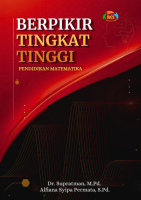
Berpikir Tingkat Tinggi Pendidikan Matematika
Synopsis
SPESIFIKASI BUKU
Harga : Rp 565.000
Ukuran : 21 cm x 29,7 cm
Jumlah Halaman : hal
Ketebalan Buku : 1 cm
ISBN : On Proses
Deskripsi Buku : Perkembangan ilmu pengetahuan dan teknologi menuntut peserta didik untuk tidak hanya menguasai pengetahuan faktual, tetapi juga memiliki kemampuan berpikir tingkat tinggi yang meliputi kemampuan berpikir kritis, kreatif, reflektif, dan pemecahan masalah. Dalam konteks pembelajaran matematika, kemampuan tersebut menjadi sangat penting karena matematika tidak hanya berperan sebagai alat hitung, tetapi juga sebagai sarana untuk melatih penalaran logis, analitis, dan sistematis. Oleh karena itu, buku ini hadir untuk memberikan landasan konseptual sekaligus praktis mengenai berbagai proses berpikir dalam matematika serta indikator kemampuan berpikir tingkat tinggi yang dapat dikembangkan dalam pembelajaran. Setiap pembahasan disusun secara sistematis dan didukung oleh kajian teoritis yang relevan, sehingga diharapkan dapat menjadi referensi ilmiah bagi pendidik, mahasiswa, peneliti, maupun praktisi pendidikan matematika. Penulisan buku ini tidak terlepas dari dukungan berbagai pihak yang telah memberikan motivasi, masukan, dan kontribusi selama proses penyusunan.
REFERENSI :
Ananiadou, K., & Claro, M. (2009). 21st-century skills and competences for new millennium learners in OECD countries. OECD Education Working Papers, 41. https://doi.org/10.1787/218525261154
Anderson, L. W., & Krathwohl, D. R. (2001). A taxonomy for learning, teaching, and assessing: A revision of Bloom’s taxonomy of educational objectives. New York: Longman.
Aristotle. (1984). The complete works of Aristotle (Vol. 1). Princeton: Princeton University Press.
Bell, S. (2010). Project-based learning for the 21st century: Skills for the future. The Clearing House: A Journal of Educational Strategies, Issues, and Ideas, 83(2), 39–43.
Bloom, B. S. (1956). Taxonomy of educational objectives: The classification of educational goals. New York: Longmans, Green.
Bereiter, C., & Scardamalia, M. (1993). Surpassing ourselves: An inquiry into the nature and implications of expertise. Open Court.
Brookhart, S. M. (2010). How to assess higher-order thinking skills in your classroom. Alexandria, VA: ASCD.
Brown, A. L. (1987). Metacognition, executive control, self-regulation, and other more mysterious mechanisms. In Metacognition, motivation, and understanding (pp. 65–116).
Bruner, J. S. (1961). The act of discovery. Harvard Educational Review, 31(1), 21–32.
Buxton, C., & Provenzo, E. (2011). Teaching science in elementary and middle school: A cognitive and cultural approach. SAGE.
Clark, R. C., & Mayer, R. E. (2016). E-learning and the science of instruction: Proven guidelines for consumers and designers of multimedia learning (4th ed.). Wiley.
Copi, I. M., Cohen, C., & McMahon, K. (2014). Introduction to logic (14th ed.). London: Routledge.
Costa, A. L., & Kallick, B. (2008). Learning and leading with habits of mind: 16 essential characteristics for success. ASCD.
Coyle, D. (2007). Content and language integrated learning: Towards a connected research agenda for CLIL pedagogies. International Journal of Bilingual Education and Bilingualism, 10(5), 543–562.
Darling-Hammond, L., et al. (2020). The flat world and education: How America’s commitment to equity will determine our future. Teachers College Press.
Dede, C. (2009). Comparing frameworks for 21st-century skills. In 21st century skills: Rethinking how students learn (pp. 51–76).
Dewey, J. (1938). Experience and education. Macmillan.
Donnelly, R., & Fitzmaurice, M. (2005). Collaborative project-based learning and problem-based learning in higher education. Emerging Issues in the Practice of University Learning and Teaching, 1(1), 87–98.
Torrance, E. P. (1974). Torrance tests of creative thinking. Scholastic Testing Service.
Ertmer, P. A., & Newby, T. J. (2013). Behaviorism, cognitivism, constructivism: Comparing critical features from an instructional design perspective. Performance Improvement Quarterly, 26(2), 43–71.
Facione, P. A. (2015). Critical thinking: What it is and why it counts. Millbrae, CA: Insight Assessment.
Fisher, R. (2007). Teaching thinking: Philosophical enquiry in the classroom. Bloomsbury.
Fullan, M. (2013). The new meaning of educational change. Teachers College Press.
Gee, J. P. (2007). What video games have to teach us about learning and literacy. Palgrave Macmillan.
Gikandi, J. W., Morrow, D., & Davis, N. E. (2011). Online formative assessment in higher education: A review of the literature. Computers & Education, 57(4), 2333–2351.
Halpern, D. F. (2014). Thought and knowledge: An introduction to critical thinking. Psychology Press.
Hanna, G., & de Villiers, M. (2012). Proof and proving in mathematics education. Dordrecht: Springer.
Harasim, L. (2012). Learning theory and online technologies. Routledge.
Hattie, J. (2008). Visible learning: A synthesis of over 800 meta-analyses relating to achievement. Routledge.
Hiebert, J., & Stigler, J. W. (2004). A world of difference: The teaching gap in international perspective. Journal of Curriculum Studies, 36(2), 135–148.
Hitchcock, D., & Verheij, B. (2006). Arguing on the Toulmin model: New essays in argument analysis and evaluation. Springer.
Johnson, D. W., & Johnson, R. T. (2009). Joining together: Group theory and group skills. Pearson.
Johnson, L., Adams Becker, S., Estrada, V., & Freeman, A. (2015). NMC Horizon Report: 2015 K–12 edition. The New Media Consortium.
Jonassen, D. H. (2011). Learning to solve problems: A handbook for designing problem-solving learning environments. Routledge.
Kilpatrick, J., Swafford, J., & Findell, B. (2001). Adding it up: Helping children learn mathematics. Washington, DC: National Academy Press.
King, A. (1993). From sage on the stage to guide on the side. College Teaching, 41(1), 30–35.
Koehler, M. J., & Mishra, P. (2005). Technological pedagogical content knowledge. Journal of Educational Computing Research, 32(2), 131–152.
Laurillard, D. (2012). Teaching as a design science: Building pedagogical patterns for learning and technology. Routledge.
Magnani, L. (2001). Abduction, reason, and science: Processes of discovery and explanation. New York: Kluwer Academic.
Marzano, R. J. (2001). Classroom instruction that works. ASCD.
Mayer, R. E. (2009). Multimedia learning. Cambridge University Press.
McLoughlin, C., & Lee, M. J. W. (2010). Personalised and self-regulated learning in the Web 2.0 era. Australasian Journal of Educational Technology, 26(1), 28–43.
Mezirow, J. (1997). Transformative learning: Theory to practice. New Directions for Adult and Continuing Education, 74, 5–12.
National Council of Teachers of Mathematics. (2000). Principles and standards for school mathematics. NCTM.
National Research Council. (2001). Adding it up: Helping children learn mathematics. Washington, DC: National Academy Press.
Newell, A., & Simon, H. A. (1972). Human problem solving. Prentice-Hall.
OECD. (2018). The future of education and skills: Education 2030. OECD Publishing.
Peirce, C. S. (1931). Collected papers of Charles Sanders Peirce (Vols. 1–6). Cambridge, MA: Harvard University Press.
Perkins, D. N. (1992). Smart schools: Better thinking and learning for every child. Free Press.
Piaget, J. (1970). Science of education and the psychology of the child. New York: Viking Press.
Piaget, J. (1971). The theory of stages in cognitive development.
Polya, G. (1954). Mathematics and plausible reasoning. Princeton University Press.
Polya, G. (1957). How to solve it (2nd ed.). Princeton University Press.
Resnick, L. B. (1987). Education and learning to think. National Academies Press.
Robinson, K. (2011). Out of our minds: Learning to be creative. Wiley.
Rotherham, A. J., & Willingham, D. (2010). “21st-century” skills: Not new, but a worthy challenge. American Educator, 34(1), 17–20.
Salomon, G., & Perkins, D. N. (1998). Individual and social aspects of learning. Review of Research in Education, 23, 1–24.
Sawyer, R. K. (2014). The Cambridge handbook of the learning sciences. Cambridge University Press.
Scardamalia, M., & Bereiter, C. (2006). Knowledge building: Theory, pedagogy, and technology. In The Cambridge handbook of the learning sciences (pp. 97–115).
Schleicher, A. (2019). PISA 2018 insights and interpretations. OECD Publishing.
Shulman, L. S. (1987). Knowledge and teaching: Foundations of the new reform. Harvard Educational Review, 57(1), 1–22.
Siemens, G. (2005). Connectivism: A learning theory for the digital age. International Journal of Instructional Technology and Distance Learning, 2(1), 3–10.
Silverman, L. K. (2002). Upside-down brilliance: The visual-spatial learner. DeLeon.
Slavin, R. E. (2006). Educational psychology: Theory and practice. Pearson.
Spencer, J. A., & Jordan, R. K. (1999). Learner-centred approaches in medical education. British Medical Journal, 318(7193), 1280–1283.
Brown, S. I., & Walter, M. (2005). The art of problem posing. Lawrence Erlbaum Associates.
Sternberg, R. J., & Grigorenko, E. L. (2007). Teaching for successful intelligence. Corwin Press.
Published
April 14, 2026
Copyright (c) 2026 Perkumpulan Rumah Cemerlang Indonesia
Details about the available publication format: Pratinjau Buku
Pratinjau Buku
Physical Dimensions
Details about the available publication format: Beli Buku
Beli Buku


