
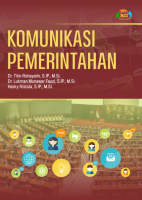
Komunikasi Pemerintahan
Synopsis
SPESIFIKASI BUKU
Harga : Rp 125.000
Ukuran : 18 cm x 25 cm
Jumlah Halaman : 230 hal
Ketebalan Buku : 1 cm
ISBN : On Proses
Deskripsi Buku : Buku ini disusun sebagai salah satu upaya untuk memenuhi kebutuhan literatur akademis yang komprehensif bagi mahasiswa dan praktisi di bidang ilmu komunikasi, ilmu politik, dan administrasi publik di Indonesia. Perkembangan teknologi informasi yang pesat dan meningkatnya tuntutan publik akan transparansi serta akuntabilitas telah mengubah lanskap komunikasi sektor publik secara fundamental. Fenomena ini menuntut adanya pemahaman yang mendalam dan kerangka kerja yang relevan untuk mengelola interaksi antara pemerintah, warga negara, dan berbagai pemangku kepentingan lainnya. Kehadiran buku ini didasari oleh urgensi untuk menyediakan panduan yang tidak hanya teoretis, tetapi juga kontekstual dengan dinamika pemerintahan di Indonesia. Tantangan seperti penyebaran disinformasi, polarisasi politik, dan kebutuhan akan komunikasi krisis yang efektif menjadi latar belakang utama penyusunan setiap bab. Buku ini dirancang untuk menjembatani kesenjangan antara teori-teori klasik komunikasi dengan aplikasi praktis di era digital, dengan harapan dapat membekali pembaca dengan pengetahuan dan keterampilan yang dibutuhkan untuk menjadi komunikator pemerintahan yang andal, etis, dan strategis.
REFERENSI :
Adha, M. M., & Anoraga, P. (2021). Pentingnya empati untuk meningkatkan kualitas pelayanan publik. Jurnal Inovasi Penelitian, 1(12), 2739–2746.
Allan, S. (Ed.). (2013). The Routledge companion to citizen journalism. Routledge.
Almond, G. A., & Powell, G. B. (2019). Comparative politics: A theoretical framework. Pearson.
Alon-Barkat, S. (2019). Can government public communications elicit undue trust? Exploring the interaction between symbols and substantive information in communications. Journal of Public Administration Research and Theory. https://doi.org/10.1093/jopart/muz013
Al-Otaibi, Z. (2025). The effectiveness of government communication in Qatar and its impact on public satisfaction. Journal of Ecohumanism. https://doi.org/10.62754/joe.v4i1.6409
Androutsopoulou, A., Karacapilidis, N., Loukis, E., & Charalabidis, Y. (2019). Transforming the communication between citizens and government through AI-guided chatbots. Government Information Quarterly, 36(2), 358–367.
Anwar, A. (2022). Ilmu komunikasi. Kencana.
Ardianto, E. (2019). Komunikasi organisasi. PT Remaja Rosdakarya.
Asosiasi Riset Opini Publik Indonesia. (2021). Pedoman etik dan praktik riset opini publik. AROPI Press.
Auer, M. R. (2021). What’s on their minds? A methodology for public-policy audience analysis. Journal of Public Affairs, 21(3), e2545. https://doi.org/10.1002/pa.2545
Babbie, E. R. (2020). The practice of social research (15th ed.). Cengage Learning.
Baker, S., & Martinson, D. L. (2001). The TARES test: Five principles for ethical persuasion. Journal of Mass Media Ethics, 16(2–3), 148–175.
Bastos, M. T., & Mercea, D. (2019). The platforms of collective action: Digital social networks and protest. In The Oxford handbook of social media and politics. Oxford University Press.
Bennett, W. L., & Iyengar, S. (2008). A new era of minimal effects? The changing foundations of political communication. Journal of Communication, 58(4), 707–731.
Bertalanffy, L. von. (1968). General system theory: Foundations, development, applications. George Braziller.
Bertot, J. C., Jaeger, P. T., & Grimes, J. M. (2010). Using ICTs to create a culture of transparency: E-government and social media as openness and anti-corruption tools for societies. Government Information Quarterly, 27(3), 264–271.
Bovaird, T., & Löffler, E. (2012). From engagement to coproduction: The contribution of users and communities to outcomes and public value. VOLUNTAS: International Journal of Voluntary and Nonprofit Organizations, 23(4), 1119–1138.
Bovens, M. (2007). Analysing and assessing accountability: A conceptual framework. European Law Journal, 13(4), 447–468.
Bowman, S., & Willis, C. (2003). We media: How audiences are shaping the future of news and information. The Media Center at the American Press Institute.
Budiardjo, M. (2018). Dasar-dasar ilmu politik (Edisi revisi). Gramedia Pustaka Utama.
Burleson, B. R. (2007). Constructivism: A general theory of communication skill. In B. B. Whaley & W. Samter (Eds.), Explaining communication: Contemporary theories and exemplars (pp. 105–128). Lawrence Erlbaum Associates.
Canel, M. J., & Sanders, K. (2012). Government communication: An emerging field in political communication research. In H. A. Semetko & M. Scammell (Eds.), The SAGE handbook of political communication (pp. 85–96). Sage.
Cangara, H. (2022). Pengantar ilmu komunikasi. PT RajaGrafindo Persada.
Castells, M. (2013). Communication and power (2nd ed.). Oxford University Press.
Chafik, M., & Benjelloun, A. (2025). Mapping the field of government communication: A bibliometric analysis. Multidisciplinary Science Journal. https://doi.org/10.31893/multiscience.2025521
Coombs, W. T. (2014). Ongoing crisis communication: Planning, managing, and responding (4th ed.). SAGE Publications.
Coronel, S. S. (2010). The media as watchdog. In The Oxford handbook of international broadcasting. Oxford University Press.
Crable, R. E., & Vibbert, S. L. (1985). Managing issues and influencing public policy. Public Relations Review, 11(2), 3–16.
Curran, J. (2019). Media and power. Routledge.
Cutlip, S. M., Center, A. H., & Broom, G. M. (2012). Effective public relations (11th ed.). Pearson.
Daft, R. L., & Lengel, R. H. (1986). Organizational information requirements, media richness, and structural design. Management Science, 32(5), 554–571.
Dalton, R. J., & Wattenberg, M. P. (Eds.). (2021). Parties without partisans: Political change in advanced industrial democracies. Oxford University Press.
Davis, A. (2019). Political communication: A new introduction for the 21st century. Polity Press.
De Benedictis-Kessner, J. (2021). Strategic government communication about performance. Political Science Research and Methods, 10, 601–616. https://doi.org/10.1017/psrm.2021.7
DePaula, N. (2022). Political ideology and information technology in government online communication. Government Information Quarterly, 40, 101747. https://doi.org/10.1016/j.giq.2022.101747
DePaula, N., Dincelli, E., & Harrison, T. M. (2018). Toward a typology of government social media communication: Democratic goals, symbolic acts, and self-presentation. Government Information Quarterly, 35(1), 98–108.
DePaula, N., & Hansson, S. (2025). Politicization of government social media communication: A linguistic framework and case study. Social Media + Society. https://doi.org/10.1177/20563051251333486
Dietrich, G. (2014). Spin sucks: Communication and reputation management in the digital age. Que Publishing.
Dwiyanto, A. (2021). Mewujudkan good governance melalui pelayanan publik. Gadjah Mada University Press.
Entman, R. M. (2007). Framing bias: Media in the distribution of power. Journal of Communication, 57(1), 163–173.
Fairbanks, J., Plowman, K. D., & Rawlins, B. L. (2007). Transparency in government communication. Journal of Public Affairs, 7(1), 23–37.
Published
February 23, 2026
Copyright (c) 2026 Perkumpulan Rumah Cemerlang Indonesia
Details about the available publication format: Pratinjau Buku
Pratinjau Buku
Physical Dimensions
Details about the available publication format: Beli Buku
Beli Buku


