
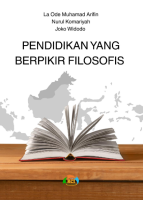
Pendidikan Yang Berpikir Filosofis
Synopsis
SPESIFIKASI BUKU
Harga : Rp 45.000
Ukuran : 18 cm x 25 cm
Jumlah Halaman : 74 hal
Ketebalan Buku : 1 cm
ISBN : On Proses
Deskripsi Buku : Buku ini lahir dari kegelisahan sekaligus harapan akan dunia pendidikan yang tidak hanya menekankan capaian teknis dan administratif, tetapi juga memberi ruang bagi proses berpikir yang mendalam, kritis, dan reflektif. Pendidikan pada hakikatnya bukan sekadar proses transfer pengetahuan, melainkan upaya membentuk manusia yang mampu berpikir, memahami makna, dan mengambil sikap secara bertanggung jawab. Berpikir filosofis dalam pendidikan berarti mengajak pendidik dan peserta didik untuk bertanya tentang tujuan belajar, nilai-nilai yang mendasari pendidikan, serta makna keberadaan manusia dalam proses pembelajaran. Melalui pendekatan filosofis, pendidikan diharapkan mampu melahirkan individu yang tidak hanya cerdas secara intelektual, tetapi juga matang secara moral dan bijaksana dalam bertindak. Buku ini disusun dengan tujuan untuk memperkaya wacana pendidikan melalui kajian filosofis yang aplikatif. Pembahasan di dalamnya mengulas hubungan antara filsafat dan pendidikan, peran berpikir kritis dan reflektif dalam proses belajar, serta implikasi pemikiran filosofis terhadap praktik pendidikan di ruang kelas dan dalam kehidupan sosial. Dengan bahasa yang komunikatif dan sistematika yang runtut, buku ini diharapkan dapat menjadi rujukan bagi mahasiswa, pendidik, peneliti, serta siapa saja yang memiliki kepedulian terhadap pengembangan pendidikan yang bermakna.
REFERENSI :
Aristotle. (1998). Metaphysics (H. Tredennick & G. C. Armstrong, Trans.). Harvard University Press. (Original work published ca. 4th century BCE)
Aquinas, T. (2002). Summa theologica (Fathers of the English Dominican Province, Trans.). Christian Classics. (Original work published 1265–1274)
Berkeley, G. (1710). A treatise concerning the principles of human knowledge. Jeremy Pepyat.
Biesta, G. J. (2003). Pragmatism and educational research. Rowman & Littlefield.
Biesta, G. J. (2010). Good education in an age of measurement: Ethics, politics, democracy. Routledge.
Blackburn, S. (2016). The Oxford dictionary of philosophy (3rd ed.). Oxford University Press.
Brookfield, S. D., & Preskill, S. (2005). Discussion as a way of teaching: Tools and techniques for democratic classrooms (2nd ed.). Jossey-Bass.
Council, N. R. → lihat National Research Council.
Creswell, J. W. (2018). Designing and conducting mixed methods research (3rd ed.). SAGE Publications.
Darling-Hammond, L. (2017). Teacher education around the world: What can we learn from international practice? European Journal of Teacher Education, 40(3), 291–309. https://doi.org/10.1080/02619768.2017.1315399
Dewey, J. (1938). Experience and education. Macmillan.
Dewey, J. (1961). Democracy and education: An introduction to the philosophy of education. Macmillan.
Freire, P. (1970). Pedagogy of the oppressed. Continuum.
Freeley, A. J. (2009). Argumentation and debate: Critical thinking for reasoned decision making (12th ed.). Wadsworth Cengage Learning.
Gardner, H. (1983). Frames of mind: The theory of multiple intelligences. Basic Books.
Gosenpud, J. J. (1998). Teaching business ethics: Effective learning through simulation. Journal of Business Ethics, 17(2), 133–140. https://doi.org/10.1023/A:1005717901258
Gosenpud, J. J. (1998). Using computer-based business simulations in business ethics education: An empirical study. Journal of Business Ethics, 17(8), 849–866.
Goodenow, C. (1993). Classroom belonging among early adolescent students: Relationships to motivation and achievement. Journal of Early Adolescence, 13(1), 21–43.
Gutek, G. L. (2014). Philosophical, ideological, and theoretical perspectives on education (2nd ed.). Pearson Education.
Haki, U., Suciati, Widodo, J., & Tabroni. (2024). Merajut cakrawala pemahaman: Epistemologi ilmu pendidikan dan metode ilmiah dalam menjelajahi hakikat serta batas ilmu pengetahuan. Perkumpulan Rumah Cemerlang Indonesia (IKAPI Jawa Barat).
Hasibuan, N. S., Widodo, J., & Tabroni. (2024). Menyibak takbir pendidikan: Kajian filsafat ilmu pendidikan untuk pembaharuan. Perkumpulan Rumah Cemerlang Indonesia (IKAPI).
Hegel, G. W. F. (1807). Phenomenology of spirit. Joseph Anton Goebhardt.
Heidegger, M. (1962). Being and time (J. Macquarrie & E. Robinson, Trans.). Harper & Row. (Original work published 1927)
Herreid, C. F. (1998). What makes a good case? Journal of College Science Teaching, 27(3), 163–165.
James, W. (1907). Pragmatism: A new name for some old ways of thinking. Longmans, Green, and Co.
Kant, I. (1781). Critique of pure reason. Johann Friedrich Hartknoch.
Kemdikbud RI. (2020). Laporan evaluasi sistem pendidikan nasional. Kementerian Pendidikan dan Kebudayaan RI.
Kemdikbud RI. (2024). Kurikulum Merdeka tingkatkan kualitas pembelajaran dan hasil belajar siswa. Kemdikbud RI.
Kierkegaard, S. (1985). The concept of anxiety (R. Thomte & A. B. Anderson, Trans.). Princeton University Press.
Kolb, D. A. (1984). Experiential learning: Experience as the source of learning and development. Prentice-Hall.
Law, S. (2011). The philosophy gym: 25 short adventures in thinking. Oxford University Press.
Lipman, M. (2003). Thinking in education (2nd ed.). Cambridge University Press.
National Research Council. (2012). Education for life and work: Developing transferable knowledge and skills in the 21st century. National Academies Press.
Noddings, N. (1997). Philosophy of education: The philosophical and educational thought of John Dewey. Westview Press.
Noddings, N. (2007). Philosophy of education (2nd ed.). Westview Press.
Noddings, N. (2018). Philosophy of education (4th ed.). Routledge.
Nussbaum, M. C. (1997). Cultivating humanity: A classical defense of reform in liberal education. Harvard University Press.
OECD. (2018). The future of education and skills: Education 2030. OECD Publishing.
Ornstein, A. C. (2018). Curriculum: Foundations, principles, and issues (7th ed.). Pearson Education.
Ozmon, H. A. (2013). Philosophical foundations of education (9th ed.). Pearson Education.
Paul, R., & Elder, L. (2006). Critical thinking: Tools for taking charge of your learning and your life. Foundation for Critical Thinking.
Peirce, C. S. (1878). How to make our ideas clear. Popular Science Monthly, 12, 286–302.
Piaget, J. (1972). The psychology of the child. Basic Books.
Plato. (1997). Complete works (J. M. Cooper, Ed.). Hackett Publishing.
Putnam, H. (1981). Reason, truth and history. Cambridge University Press.
Sartre, J.-P. (2007). Existentialism is a humanism (C. Macomber, Trans.). Yale University Press.
Tomlinson, C. A. (2001). How to differentiate instruction in mixed-ability classrooms (2nd ed.). ASCD.
UNESCO. (2015a). Education for sustainable development goals: Learning objectives. UNESCO.
UNESCO. (2015b). Education for all 2000–2015: Achievements and challenges. UNESCO.
UNESCO. (2015c). Education 2030: Incheon declaration and framework for action. UNESCO.
UNICEF. (2019a). The state of the world’s children 2019: Children, food and nutrition. UNICEF.
UNICEF. (2019b). Global framework on transferable skills. UNICEF.
UPI. (2024). Filsafat ilmu dalam pengembangan kurikulum pendidikan tinggi. Universitas Pendidikan Indonesia.
Vygotsky, L. S. (1978). Mind in society: The development of higher psychological processes. Harvard University Press.
Yuli, A., & Mulyani, S. (2018). Model pembelajaran filsafat ilmu berbasis diskusi untuk meningkatkan kemampuan berpikir kritis mahasiswa. Jurnal Penelitian Pendidikan, 18(2), 127–134.
Zahroni, A., Widodo, J., & Tabroni. (2024). Pembentukan karakter melalui pendidikan Islam pendekatan aksiologi. Perkumpulan Rumah Cemerlang Indonesia (IKAPI).
Published
January 19, 2026
Copyright (c) 2026 Perkumpulan Rumah Cemerlang Indonesia
Details about the available publication format: Pratinjau Buku
Pratinjau Buku
Physical Dimensions
Details about the available publication format: Beli Buku
Beli Buku


