
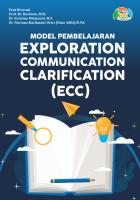
Model Pembelajaran Exploration, Communication, Clarification (ECC)
Synopsis
SPESIFIKASI BUKU
◉ Harga : Rp 65.000
◉ Ukuran : 14 cm x 21 cm
◉ Jumlah Halaman : 96 hal
◉ Ketebalan Buku : 1 cm
◉ ISBN : On Proses
◉ Deskripsi Buku :
Model pembelajaran yang ditawarkan dalam buku ini berlandaskan pada teori perkembangan zona dari Valsiner yakni Zone of Free Movement (ZFM), Zone of Promoted Action (ZPA), dan Zone of Proximal Development (ZPD) yang memberikan perspektif baru dalam mengelola pembelajaran secara dinamis dan berorientasi pada perkembangan kognitif siswa. Melalui tiga fase utama: Exploration, Communication, dan Clarification, model ini dirancang untuk menstimulasi pemikiran kritis siswa secara sistematis dan terarah.
References
Abuhassna, H., & Alnawajha, S. (2023). Instructional design models for digital learning: A systematic review. International Journal of Emerging Technologies in Learning, 18(4), 45–62.
Abuhassna, H., Adnan, M. A. B. M., & Awae, F. (2024). Exploring the synergy between instructional design models and learning theories: A systematic literature review. Contemporary Educational Technology, 16(2), ep499. https://doi.org/10.30935/cedtech/14289
Afandi, A., & Suryadi, D. (2023). Problem-solving based instruction to promote students’ mathematical reasoning and critical thinking. Journal on Mathematics Education, 14(1), 55–70.
Ahmad, S. (2024). Integrative learning models in higher education: A theoretical framework. Educational Research and Reviews, 19(2), 102–117.
Akmam, A., Yusuf, M., & Hadi, S. (2024). Cognitive conflict as a trigger for conceptual change in mathematics learning. International Journal of Instruction, 17(1), 88–103.
Al-Zoubi, A. (2023). Pedagogical models for online and blended learning environments: Design implications and best practices. Education and Information Technologies, 28(6), 7337–7353.
Anwar, Z., Supriadi, S., Hamid, A., Mahmuri, H., Liani, A. M., & Nurmala, R. (2023). Developing mathematical critical thinking indicators for 21st century learning. Journal of Research and Advances in Mathematics Education, 8(1), 45–62.
Arthur, J., Davis, R., & Jones, P. (2018). Designing inquiry-based tasks to foster students’ critical reasoning. Mathematics Teacher Education and Development, 20(2), 78–95.
Asyafah, A. (2016). Model-model pembelajaran dalam perspektif teori belajar. Bandung: Alfabeta.
Bjorklund, D. F. (2022). Children’s thinking: Cognitive development and individual differences (8th ed.). Sage.
Blanton, M., Westbrook, S., & Carter, G. (2005). Using Vygotsky’s zone of proximal development to explore teacher learning. Journal of Mathematics Teacher Education, 8(5), 345–368. https://doi.org/10.1007/s10857-005-0935-1
Carey, S. (2015). The origin of concepts. Oxford University Press.
Cahyono, B., Kartono, ., Waluya, S. B., & Mulyono, . (2020). Critical thought processes in solving problems reviewed from the high level mathematical ability. In Proceedings of the International Conference on Science and Education and Technology (ISET 2019) (pp. 373–376). Atlantis Press. https://doi.org/10.2991/assehr.k.200620.072
Carvalho, J., Almeida, M., & Torres, A. (2023). Constructivist approaches in mathematics education: From Piaget to digital learning. European Journal of Educational Research, 12(3), 1012–1024.
Chen, L. (2020). Piaget’s cognitive constructivism revisited in the digital era. Frontiers in Education, 5, 22–31.
Chen, W., Li, X., & Zhao, T. (2025). Effects of flipped classroom models on student engagement and achievement in science education. Journal of Science Education and Technology, 34(2), 290–308.
Deng, Y. (2025). Constructivist learning and collaborative classroom environments in mathematics education. Asia Pacific Education Review, 26(1), 22–35.
Dewi, O., & Wijayanti, K. (2022). Mathematical critical thinking ability in terms of students … Unnes Journal of Mathematics Education. (Vol.11(2), 183-190) https://doi.org/10.15294/ujme.v11i2.59937
Disch, P., Edwards, L., & Wang, Q. (2024). Active cognitive engagement in constructivist learning environments. Learning and Instruction, 89, 101774.
Do, T. (2023). Constructivism in practice: Student engagement and cognitive interaction in mathematics classrooms. International Journal of Learning Sciences, 15(4), 325–341.
Edward, M. G. (1941). An experiment in the development of critical thinking. Columbia University.
Eliyasni, E., Kenedi, A. K., & Sayer, I. (2019). The role of scaffolding in mathematical learning for conceptual understanding. Infinity Journal, 8(2), 137–148.
Ennis, R. H. (1991). Critical thinking. Prentice-Hall.
Ennis, R. H. (2011). The nature of critical thinking: An outline of critical thinking dispositions and abilities. University of Illinois.
Ennis, R. H. (2018). Critical thinking across the curriculum: A vision for thinking and learning. Rowman & Littlefield.
Erawati, N., & Adnyana, G. (2024). Revisiting Piagetian constructivism in mathematics education. Journal of Educational Studies, 15(1), 45–58.
Facione, P. A. (1990). The Delphi report: Critical thinking: A statement of expert consensus for purposes of educational assessment and instruction. American Philosophical Association.
Facione, P. A. (2015). Critical thinking: What it is and why it counts (6th ed.). Insight Assessment.
Fiantika, F., Anggraini, M., & Rahmawati, S. (2021). Analyzing Indonesian students’ reasoning ability based on TIMSS data. Journal on Mathematics Education, 12(3), 345–359.
Fisher, A. (2008). Critical thinking: An introduction (2nd ed.). Cambridge University Press.
Furness, S., McKnight, A., & O’Donnell, J. (2017). Critical mathematics for social justice. Educational Studies in Mathematics, 95(3), 311–329.
Goos, M., & Bennison, A. (2019). A zone theory approach to analysing identity formation in mathematics education. ZDM – Mathematics Education, 51(3), 405–418. https://doi.org/10.1007/s11858-018-1011-8
Hadi, S., Retnowati, E., & Budiyono, B. (2021). Developing students’ critical mathematical thinking through problem-based learning. International Journal of Instruction, 14(2), 355–370.
Halpern, D. F. (2014). Thought and knowledge: An introduction to critical thinking (5th ed.). Psychology Press.
Hattie, J. (2021). Visible learning: The sequel. Routledge. https://doi.org/10.4324/9781003024477
Heaster-Ekholm, C. (2020). Instructional models in cultural contexts: A philosophical perspective. Educational Philosophy and Theory, 52(14), 1523–1537.
Izzati, N. N., & Dewi, N. R. (2023). Development of STEAM-based mathematics teaching materials on direct and inverse proportion to improve mathematical problem-solving ability and self-regulated learning. Unnes Journal of Mathematics Education, 12(1), 51-59. https://doi.org/10.15294/ujme.v12i1.68735
Jäder, J., Lithner, J., & Sidenvall, J. (2020). Mathematical problem solving in textbooks from twelve countries. International Journal of Mathematical Education in Science and Technology, 51(4), 557–572. https://doi.org/10.1080/0020739X.2019.1656826
Johnson, E. B. (2007). Contextual teaching and learning: What it is and why it’s here to stay. Corwin Press.
Kartono, ., Mulyono, ., & Waluya, S. B. (2019). Analysis of mathematical critical thinking ability of students based on diagnostic assessment. Journal of Physics: Conference Series, 1321(3), 032084. https://doi.org/10.1088/1742-6596/1321/3/032084
Kay, K., & Greenhill, V. (2021). Twenty-first century skills for students and teachers. Educational Leadership, 78(3), 46–52.
Kemdikbud. (2013). Kurikulum 2013: Kompetensi dasar dan standar proses. Jakarta: Kemendikbud RI.
Khosravi, H., Buckingham, S., Chen, G., & Conati, C. (2022). Computers and Education : Artificial Intelligence Explainable Artificial Intelligence in education. 3(March). https://doi.org/10.1016/j.caeai.2022.100074
Khusna, F., Rosyid, M. F., & Nugraha, A. (2024). Mathematical critical thinking in collaborative problem solving: A social-cognitive approach. Journal on Mathematics Education, 15(1), 77–95.
Kirschner, P. A., Paas, F., & Kirschner, F. (2018). From Cognitive Load Theory to collaborative cognitive load: A progress report. International Journal of Computer-Supported Collaborative Learning, 13(2), 213–233.
Krulik, S., & Rudnick, J. (1995). Reasoning and problem solving: A handbook for elementary school teachers. Allyn and Bacon.
Kuntze, S., Aizikovitsh-Udi, E., & Clarke, D. J. (2017). Hybrid task design: Connecting learning opportunities related to critical thinking and statistical thinking. ZDM – Mathematics Education, 49(6), 923–935. https://doi.org/10.1007/s11858-017-0874-4
Kusuma, D., Wulandari, I., & Sari, P. (2022). Enhancing mathematical critical thinking through problem-based learning in geometry. Jurnal Pendidikan Matematika Indonesia, 7(2), 145–158.
Lai, K. W. (2022). Learning design and models for 21st century education. British Journal of Educational Technology, 53(5), 1325–1342.
Le, H. Van, & Nguyen, L. Q. (2024). Promoting L2 learners’ critical thinking skills: the role of social constructivism in reading class. Frontiers in Education, 9(June), 1–12. https://doi.org/10.3389/feduc.2024.1241973
Leung, A. (2023). Children’s knowledge construction of computational thinking through exploration. Computers & Education, 198, 104723.
Li, J., & Li, Y. (2024). Cognitive apprenticeship in mathematics instruction: Scaffolding students’ higher-order thinking. Educational Studies in Mathematics, 117(1), 19–42.
Lithner, J. (2020). Mathematical reasoning in school tasks: What it is and how to promote it. Nordic Studies in Mathematics Education, 25(2), 5–24.
Loong, E., Anderson, M., & Calder, N. (2021). Critical thinking in mathematics education: A cross-national perspective. International Journal of Mathematical Education in Science and Technology, 52(5), 693–711.
Lowell, J., & Urena Rodriguez, M. (2023). Taxonomy of instructional design models in education. Educational Review, 75(2), 227–245.
Martin, A. J., & Evans, M. (2021). Cognitive load theory and classroom learning. Educational Psychologist, 56(4), 240–255.
Mayer, R. E. (2020). The science of learning. Yale University Press.
Monteleone, C., Miller, J., & Warren, E. (2023). Critical mathematical thinking framework for 21st century classrooms. Journal of Educational Research and Practice, 13(1), 11–25.
Mullis, I. V. S., Martin, M. O., & Loveless, T. (2020). TIMSS 2019 international results in mathematics and science. TIMSS & PIRLS International Study Center.
NCTM. (2000). Principles and standards for school mathematics. National Council of Teachers of Mathematics.
Nieveen, N. (2013). An introduction to educational design research. Netherlands Institute for Curriculum Development (SLO).
OECD. (2019). PISA 2018 results (Volume I): What students know and can do. OECD Publishing.
Paul, R., & Elder, L. (2005). Critical thinking: Tools for taking charge of your learning and your life. Pearson.
Paul, R., & Elder, L. (2006). The miniature guide to critical thinking: Concepts and tools. Foundation for Critical Thinking.
Pramasdyahsari, S., Darhim, D., & Prabawanto, S. (2023). Students’ mathematical critical thinking skills in the era of education 4.0. Journal of Mathematics Education Research, 8(1), 23–40.
Rahmasari, D. (2023). Mathematical critical thinking and its role in problem solving. Infinity Journal, 12(2), 187–201.
Rakesh, D., Mclaughlin, K. A., Sheridan, M., Humphreys, K. L., & Rosen, M. L. (2024). Environmental contributions to cognitive development : The role of cognitive stimulation. Developmental Review, 73(June), 101135. https://doi.org/10.1016/j.dr.2024.101135
Retnowati, E., Ayres, P., & Sweller, J. (2017). Can collaborative learning improve the effectiveness of worked examples in learning mathematics? Journal of Educational Psychology, 109(5), 666–679. https://doi.org/10.1037/edu0000167
Retnowati, E., Ayres, P., & Sweller, J. (2018). Collaborative learning effects when students have complete or incomplete knowledge. Applied Cognitive Psychology, 32(5), 681–692. https://doi.org/10.1002/acp.3444
Ritzhaupt, A. D., & Martin, F. (2020). An examination of the systemic reach of instructional design models: A systematic review. TechTrends, 64(5), 710–719. https://doi.org/10.1007/s11528-020-00539-8
Romadiastri, N., Sari, D. M., & Rahmawati, T. (2021). Visual representation and critical thinking in mathematical problem solving. Journal of Mathematics Education Research, 7(2), 78–89.
Rott, B. (2021). Inductive and deductive justification of knowledge: Epistemological beliefs and critical thinking at the beginning of studying mathematics. Educational Studies in Mathematics, 107(3), 399–421. https://doi.org/10.1007/s10649-020-10004-1
Sachdeva, S., & Eggen, P.-O. (2021). Learners’ critical thinking about learning mathematics. International Electronic Journal of Mathematics Education, 16(3), em0644. https://doi.org/10.29333/iejme/11003
Sanghvi, P. (2020). Piaget’s theory of cognitive development revisited. International Journal of Psychology and Education Studies, 7(3), 10–21. https://doi.org/10.17220/ijpes.2020.03.002
Senadheera, G., Abeysekera, L., & Widanapathirana, C. (2024). Instructional model design in digital pedagogy: Frameworks and challenges. International Journal of Educational Research, 122, 102231.
Shabani, K. (2010). Vygotsky’s zone of proximal development: Instructional implications and applications for e-learning. Contemporary Educational Technology, 1(1), 16–30.
Shokouhi, H., & Shakouri, N. (2015). A reappraisal of Vygotsky’s zone of proximal development in the light of Valsiner’s zones theory. Journal of Educational and Developmental Psychology, 5(2), 116–126.
Susanti, R., Wardani, A., & Pranoto, Y. (2020). The role of critical thinking in mathematics learning: A reflection from Indonesian context. Jurnal Riset Pendidikan Matematika, 7(1), 23–35.
Susilo, B. E., Darhim, D., & Prabawanto, S. (2020). Assessing students’ critical thinking skills in mathematical contexts. Journal on Mathematics Education, 11(3), 375–392.
Sweller, J. (2020). Cognitive load theory and educational design: Recent developments. Educational Psychology Review, 32(2), 281–296. https://doi.org/10.1007/s10648-019-09465-5
Tan, J., Wu, S., Wu, L., & Ma, S. (2025). Cognitive conflicts in collaborative programming and their impact on computational concept acquisition. Learning and Instruction, 98(September 2024), 102151. https://doi.org/10.1016/j.learninstruc.2025.102151
Umoke, J. (2025). Transformative functions of learning models in improving student understanding. International Journal of Educational Innovation, 16(1), 42–59.
Valsiner, J. (1997). Culture and the development of children’s action: A theory of human development. Wiley.
Valsiner, J., Rosa, A., & Lyra, M. (2021). Dynamic systems and cultural psychology: New perspectives on human development. Cambridge University Press.
Van de Pol, J., Mercer, N., & Howe, C. (2023). Effective scaffolding in mathematics classrooms: A review and framework. Learning and Instruction, 83, 101731. https://doi.org/10.1016/j.learninstruc.2022.101731
von Fircks, K. (2024). Applying Valsiner’s zone theory in organizational learning contexts. Human Resource Development Review, 23(1), 34–59.
Vygotsky, L. S. (1978). Mind in society: The development of higher psychological processes. Harvard University Press.
Wang, Y. (2021). Constructivist learning theory: From Piaget to the 21st century classroom. Educational Psychology Review, 33(4), 1105–1120.
Wang, Z., Liu, H., & Zhang, W. (2024). Critical thinking in mathematical reasoning: A conceptual and empirical analysis. Educational Research Review, 42, 100562. https://doi.org/10.1016/j.edurev.2023.100562
Zhang, L. (2022). Reinterpreting Piagetian cognitive development in modern education. Journal of Cognitive Science Education, 8(2), 233–248.
Published
January 7, 2026
Copyright (c) 2026 Perkumpulan Rumah Cemerlang Indonesia
Details about the available publication format: Pratinjau Buku
Pratinjau Buku
Physical Dimensions
Details about the available publication format: Beli Buku
Beli Buku


