
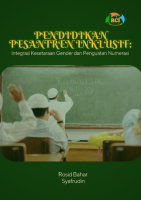
Pendidikan Pesantren Inklusif: Integrasi Kesetaraan Gender Dan Penguatan Numerasi
Synopsis
SPESIFIKASI BUKU
◉ Harga : Rp 85.000
◉ Ukuran : 18 x 25 cm
◉ Jumlah Halaman : 169 hal
◉ Ketebalan Buku : 1 cm
◉ ISBN : On Proses
◉ Deskripsi Buku : Buku ini lahir dari kepedulian sekaligus hasil kajian mendalam mengenai urgensi transformasi pendidikan pesantren agar lebih responsif terhadap perkembangan zaman, terutama dalam mewujudkan lingkungan belajar yang inklusif, berkeadilan gender, serta mampu memperkuat kompetensi numerasi para santri. Selama ini, pesantren dikenal sebagai lembaga pendidikan yang memiliki tradisi kuat serta kontribusi besar dalam membentuk karakter bangsa. Namun, tantangan global dan kebutuhan pendidikan abad ke-21 menuntut pesantren untuk terus beradaptasi. Dua isu penting yang mengemuka dalam dunia pendidikan modern adalah kesetaraan gender dan penguatan numerasi, yang keduanya memiliki peran strategis dalam meningkatkan kualitas pendidikan dan membuka peluang lebih luas bagi peserta didik untuk berkembang secara optimal. Buku ini hadir sebagai upaya menghadirkan pemahaman yang komprehensif tentang bagaimana pesantren dapat mengintegrasikan prinsip-prinsip kesetaraan gender dalam kegiatan pendidikan, serta bagaimana numerasi dapat diperkuat melalui pendekatan pembelajaran yang kontekstual dan relevan dengan kehidupan santri. Dengan menggabungkan kajian teoritis dan temuan empiris, buku ini diharapkan dapat memberikan inspirasi, rujukan, dan rekomendasi praktis bagi para pengasuh pesantren, pendidik, peneliti, dan pemerhati pendidikan. Penulis menyampaikan terima kasih yang sebesar-besarnya kepada seluruh pihak yang telah memberikan dukungan moral, akademik, dan teknis dalam proses penyusunan buku ini. Semoga buku ini dapat memberikan manfaat bagi pengembangan pendidikan pesantren yang lebih inklusif, berkeadilan, dan adaptif terhadap kebutuhan masa depan. Akhir kata, penulis berharap buku ini dapat menjadi kontribusi kecil namun berarti dalam upaya meningkatkan kualitas pendidikan pesantren di Indonesia.
REFERENSI :
Abington, C. (2015). The relationship between female education and growth in developing countries. International Journal of Economic Research, 12(3), 761–773.
Acosta-Ballesteros, J., Osorno-del Rosal, M. del P., & Rodríguez-Rodríguez, O. M. (2021). Measuring the effect of gender segregation on the gender gap in time-related underemployment. Journal for Labour Market Research, 55(1). https://doi.org/10.1186/s12651-021-00305-0
Adelia, V., & Putri, R. I. I. (2024). Mathematics teachers in Palembang teaching practice: Numeracy perspective. AIP Conference Proceedings, 3052(1). https://doi.org/10.1063/5.0201098
Adelia, V., Putri, R. I. I., & Zulkardi. (2024). A systematic literature review: How do we support students to become numerate? International Journal of Evaluation and Research in Education, 13(3), 1816–1824. https://doi.org/10.11591/ijere.v13i3.26849
Afiah, K. N., Kusmana, Rizal, A. N. S., Ningrum, D. A., Khoiri, A., & Salsabila, A. J. (2024). The social movement of women in pesantren: From empowerment to resistance against patriarchal culture. In Religion, Education, Science and Technology towards a More Inclusive and Sustainable Future (pp. 235–239). Routledge. https://doi.org/10.1201/9781003322054-40
Ahmad, N., Shaheen, N., & Hussain, S. (2024). Gender disparities in universal primary education: An analysis of women’s education and policy implications in Pakistan (1947–2017). European Journal of Education, 59(2). https://doi.org/10.1111/ejed.12638
Alfaqi, M. Z. (2023). Religion-based inclusive education in building gender awareness at Qomaruddin Islamic Boarding School, Gresik, Indonesia. In Proceedings of the 4th International Conference on Law, Social Sciences, and Education (ICLSSE 2022). https://doi.org/10.4108/eai.28-10-2022.2326380
Alfredo, J. M., Nugraha, X., & Putri, D. E. K. (2022). Journal of Islamic Law. Mizan: Journal of Islamic Law, 6(1), 119–134. https://doi.org/10.32507/mizan.v6i1.1211
Algül, Y. (2024). Assessing the relationship between broad gender inequality and the gender unemployment gap: Insights from an extensive global macroeconometric panel analysis. Discover Sustainability, 5(1). https://doi.org/10.1007/s43621-024-00663-y
Allwood, G. (2020). Gender equality in European Union development policy in times of crisis. Political Studies Review, 18(3), 329–345. https://doi.org/10.1177/1478929919863224
Almarashdi, H. S., & Jarrah, A. M. (2023). Assessing tenth-grade students’ mathematical literacy skills in solving PISA problems. Social Sciences, 12(1). https://doi.org/10.3390/socsci12010033
Amalina, I. K., & Vidákovich, T. (2023). Cognitive and socioeconomic factors influencing students’ mathematical problem-solving skills. Heliyon, 9(9). https://doi.org/10.1016/j.heliyon.2023.e19539
Amelia, R. N., Astuti, S. R. D., & Sari, A. R. P. (2022). Deteksi bias gender pada instrumen evaluasi belajar kimia dengan metode Mantel-Haenzel. Jurnal Tarbiyah, 29(2), 243–256. http://dx.doi.org/10.30829/tar.v29i2.1781
Andersen, I. G. (2023). Teachers’ gender bias in STEM: Results from a vignette study. British Educational Research Journal, 49(4), 833–851. https://doi.org/10.1002/berj.3870
Antara, A. A. P. (2020). Penyetaraan vertikal dengan pendekatan klasik dan item response theory (teori dan aplikasi). Deepublish.
Arlinwibowo, J., Retnawati, H., & Kartowagiran, B. (2021). Item response theory utilization for developing the student collaboration ability assessment scale in STEM classes. Ingénierie des Systèmes d’Information, 26(4), 409–415. https://doi.org/10.18280/isi.260409
Arlinwibowo, J., Retnawati, H., & Hadi, S. (2024). Aplikasi teori respon butir dengan R dan R Studio. Penerbit Andi.
Arroyo-Barrigüete, J. L., Carabias-López, S., Borrás-Pala, F., & Martín-Antón, G. (2023). Gender differences in mathematics achievement: The case of a business school in Spain. Sage Open, 13(2). https://doi.org/10.1177/21582440231166922
Asmara, A. S., Waluya, S. B., Suyitno, H., Junaedi, I., & Ardiyanti, Y. (2024). Developing patterns of students’ mathematical literacy processes: Insights from cognitive load theory and design-based research. Infinity Journal, 13(1), 197–214. https://doi.org/10.22460/infinity.v13i1.p197-214
Assa’idi, S. (2021). The growth of pesantren in Indonesia as the Islamic venue and social class status of santri. Eurasian Journal of Educational Research, 93, 425–440. https://doi.org/10.14689/EJER.2021.93.21
Athoillah, M., Rahman, A. S., Firdaus, A. S., & Septiadi, M. A. (2024). Policies and practices of religious moderation in pesantren. Jurnal Pendidikan Islam, 10(2), 387–396. https://doi.org/10.15575/jpi.v10i2.27543
Aunio, P., Korhonen, J., Ragpot, L., Törmänen, M., & Henning, E. (2021). An early numeracy intervention for first-graders at risk for mathematical learning difficulties. Early Childhood Research Quarterly, 55, 252–262. https://doi.org/10.1016/j.ecresq.2020.12.002
Azizah, S. N., Suradi, Koeswinarno, Fakhruddin, M., & Yuliani, I. (2024). The influence of digital transformation in speeding up the empowerment of Muslim women’s economy to improve MSMEs performance in Ponorogo. In Strategic Islamic Business and Management: Solutions for Sustainability (pp. 71–107). Springer. https://doi.org/10.1007/978-3-031-61778-2_5
Azwar, S. (2016). Dasar-dasar psikometri. Pustaka Pelajar.
Bahar, R., Istiyono, E., Widihastuti, W., Munadi, S., Nuryana, Z., & Fajaruddin, S. (2021). Analisis karakteristik soal ujian sekolah hasil musyawarah guru matematika di Tasikmalaya. Aksioma, 10(4), 2660–2674. https://doi.org/10.24127/ajpm.v10i4.4359
Bakker, M., Torbeyns, J., Wijns, N., Verschaffel, L., & De Smedt, B. (2019). Gender equality in preschoolers’ early numerical competencies. Developmental Science, 22(1). https://doi.org/10.1111/desc.12718
Balducci, M. (2023). Linking gender differences with gender equality: A systematic-narrative literature review of basic skills and personality. Frontiers in Psychology, 14, 1105234. https://doi.org/10.3389/fpsyg.2023.1105234
Published
December 4, 2025
Copyright (c) 2025 Perkumpulan Rumah Cemerlang Indonesia
Details about the available publication format: Pratinjau Buku
Pratinjau Buku
Physical Dimensions
Details about the available publication format: Beli Buku
Beli Buku


