
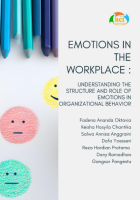
Emotions In The Workplace : Understanding The Structure And Role Of Emotions In Organizational Behavior
Synopsis
SPESIFIKASI BUKU
Harga : Rp 65.000
Ukuran : 18 cm x 25 cm
Jumlah Halaman : 156 hal
Ketebalan Buku : 1 cm
ISBN : On Proses
Deskripsi Buku : Puji syukur kami panjatkan kehadirat Tuhan Yang Maha Esa yang telah memberikan rahmat serta karunia-Nya kepada kami sehingga kami berhasil menyelesaikan Buku dengan judul Emotions in The Workplace: Understanding the Structure and Role of Emotions in Organizational Behavior sesuai yang ditargetkan. Buku ini berisikan pembahasan mendalam mengenai struktur, fungsi, dan peran emosi dalam perilaku organisasi, termasuk teori-teori afek, regulasi emosi, dinamika interpersonal, serta implikasi praktisnya terhadap kinerja, kesejahteraan, dan budaya kerja dalam organisasi modern. Kami menyadari bahwa Buku ini masih jauh dari sempurna, oleh karena itu kritik dan saran dari semua pihak yang bersifat membangun selalu kami harapkan demi kesempurnaan buku ini. Akhir kata, kami sampaikan terima kasih kepada semua pihak yang telah berperan serta dalam penyusunan Buku ini dari awal sampai akhir. Semoga Tuhan Yang Maha Esa senantiasa meridhoi segala usaha kita. Amin.
REFERENSI :
Allen, T. D., Herst, D. E., Bruck, C. S., & Sutton, M. (2000). Consequences associated with work-to-family conflict: A review and agenda for future research. Journal of Occupational Health Psychology, 5(2), 278–308. https://doi.org/10.1037/1076-8998.5.2.278
APA. (2022). Emotion regulation and workplace transition strategies. American Psychological Association.
Arvey, R. D. (2015). Genetic and environmental influences on workplace aggression. Journal of Occupational Health Psychology.
Ashforth, B. E., & Humphrey, R. H. (1993). Emotional labor in service roles: The influence of identity. Academy of Management Review, 18(1), 88–115. https://doi.org/10.5465/amr.1993.3997508
Ashkanasy, N. M., & Daus, C. S. (2002). Emotion in the workplace: The new challenge for managers. Academy of Management Executive, 16(1), 76–86.
Ashkanasy, N. M., & Dorris, A. D. (2017). Emotions in the workplace. Annual Review of Organizational Psychology and Organizational Behavior, 4, 67–90. https://doi.org/10.1146/annurev-orgpsych-032516-113231
Ashkanasy, N. M., Härtel, C. E., & Daus, C. S. (2002). Diversity and emotion: The new frontiers in organizational behavior research. Academy of Management Review.
Barger, P. B., & Grandey, A. A. (2006). Emotional contagion in service interactions. Journal of Applied Psychology, 91(6), 1220–1235.
Barsade, S. G. (2002). The ripple effect: Emotional contagion and its influence on group behavior. Administrative Science Quarterly, 47(4), 644–675.
Barsade, S. G., & Gibson, D. E. (2007). Why does affect matter in organizations? Academy of Management Perspectives, 21(1), 36–59. https://doi.org/10.5465/amp.2007.24286163
Brotheridge, C. M., & Grandey, A. A. (2002). Emotional labor and burnout: Comparing two perspectives of “people work.” Journal of Vocational Behavior, 60(1), 17–39. https://doi.org/10.1006/jvbe.2001.1815
Cameron, K., & Quinn, R. (2011). Diagnosing and changing organizational culture: Based on the competing values framework. Jossey-Bass.
Colquitt, J. A., Conlon, D. E., Wesson, M. J., Porter, C. O., & Ng, K. Y. (2001). Justice at the millennium: A meta-analytic review of 25 years of organizational justice research. Journal of Applied Psychology, 86(3), 425–445.
Côté, S. (2005). A social interaction model of the effects of emotion regulation on work strain. Academy of Management Review, 30(3), 509–530. https://doi.org/10.5465/amr.2005.17293692
Deci, E. L., & Ryan, R. M. (2000). The “what” and “why” of goal pursuits: Human needs and the self-determination of behavior. Psychological Inquiry, 11(4), 227–268.
Detert, J. R. (2022). Choosing courage: The everyday guide to being brave at work. Harvard Business Review Press.
Diefendorff, J. M., & Gosserand, R. H. (2003). Understanding the emotional labor process: A control theory perspective. Journal of Organizational Behavior, 24(8), 945–959. https://doi.org/10.1002/job.230
Diener, E., & Emmons, R. A. (1984). The independence of positive and negative affect. Journal of Personality and Social Psychology, 47(5), 1105–1117.
Earley, P. C., & Francis, C. A. (2002). International perspectives on emotion and work: Regulation and expression in cross-cultural contexts. Dalam N. M. Ashkanasy, W. J. Zerbe, & C. E. J. Härtel (Eds.), Managing emotions in the workplace (pp. 357–382). M.E. Sharpe.
Eby, L. T., Casper, W. J., Lockwood, A., Bordeaux, C., & Brinley, A. (2005). Work and family research in IO/OB: Content analysis and review of the literature (1980–2002). Journal of Vocational Behavior, 66(1), 124–197.
Edmondson, A. (2019). The fearless organization: Creating psychological safety in the workplace for learning, innovation, and growth. John Wiley & Sons.
Einarsen, S., Hoel, H., Zapf, D., & Cooper, C. L. (2011). Bullying and harassment in the workplace. CRC Press.
Eisenberger, R., & Stinglhamber, F. (2011). Perceived organizational support: Fostering enthusiastic and productive employees. American Psychological Association.
Ekman, P. (2007). Emotions revealed. Henry Holt & Company.
Faturochman. (2018). Emosi dan kesejahteraan kerja. Gadjah Mada University Press.
Febrianto, M. R., & Widiana, H. S. (2013). Efek pelayanan senyum, salam, sapa petugas kasir terhadap kepuasan konsumen supermarket. Jurnal Manajemen dan Bisnis.
Fredrickson, B. L. (2001). The role of positive emotions in positive psychology: The broaden-and-build theory of positive emotions. American Psychologist, 56(3), 218–226.
Frontiers in Psychology. (2022). Emotional adjustment and early career adaptation.
Frontiers in Psychology. (2024). Harmonizing emotions in the workplace: Exploring the interaction between emotional intelligence, positive psychological capital, and flourishing.
George, J. M. (1990). Personality, affect, and behavior in groups. Journal of Applied Psychology, 75(2), 107–116.
George, J. M. (1996). Group affective tone. Dalam M. A. West (Ed.), Handbook of work group psychology (pp. 77–93). John Wiley & Sons.
George, J. M. (2000). Emotions and leadership: The role of emotional intelligence. Human Relations, 53(8), 1027–1055.
George, J. M., & Brief, A. P. (1992). Feeling good-doing good: A conceptual analysis of the mood at work–organizational spontaneity relationship. Psychological Bulletin, 112(2), 310–329.
George, J. M., & Jones, G. R. (2012). Understanding and managing organizational behavior (6th ed.). Pearson.
Glomb, T. M., Steel, P. D. G., & Arvey, R. D. (2002). Workplace anger and aggression research. Journal of Occupational Health Psychology.
Goleman, D. (1998). Working with emotional intelligence. Bantam Books.
Goleman, D. (2015). Emotional intelligence: Why it can matter more than IQ. Bantam.
Good, D. J., Lyddy, C. J., Glomb, T. M., et al. (2016). Contemplating mindfulness at work: An integrative review. Journal of Management, 42(1), 114–142.
Grandey, A. A. (2000). Emotion regulation in the workplace: A new way to conceptualize emotional labor. Journal of Occupational Health Psychology, 5(1), 95–110.
Greenhaus, J. H., & Allen, T. D. (2011). Work–family balance: A review and extension of the literature. Journal of Management, 37(1), 10–37.
Greenhaus, J. H., & Beutell, N. J. (1985). Sources of conflict between work and family roles. Academy of Management Review, 10(1), 76–88.
Gross, J. J. (1998). The emerging field of emotion regulation: An integrative review. Review of General Psychology, 2(3), 271–299.
Gross, J. J. (2013). Emotion regulation: Conceptual and empirical foundations. Dalam J. J. Gross (Ed.), Handbook of emotion regulation (2nd ed., pp. 3–20). Guilford Press.
Gross, J. J. (2014). Emotion regulation: Conceptual and empirical foundations. Dalam J. J. Gross (Ed.), Handbook of emotion regulation (pp. 3–20). Guilford Press.
Gross, J. J., & John, O. P. (2003). Individual differences in two emotion regulation processes: Cognitive reappraisal and expressive suppression. Journal of Personality and Social Psychology, 85(2), 348.
Harvard Business Review. (2022). Why courage is the new leadership skill for the modern workplace.
Harvard Business Review. (2022). How emotional intelligence shapes career success.
Hasibuan, M. S. P. (2019). Manajemen sumber daya manusia. Bumi Aksara.
Hatfield, E., Cacioppo, J. T., & Rapson, R. L. (1994). Emotional contagion. Cambridge University Press.
Hochschild, A. R. (1983). The managed heart: Commercialization of human feeling. University of California Press.
Hülsheger, U. R., & Schewe, A. F. (2011). On the costs and benefits of emotional labor: A meta-analysis of three decades of research. Journal of Occupational Health Psychology, 16(3), 361–389.
Hülsheger, U. R., Alberts, H. J., Feinholdt, A., & Lang, J. W. (2013). Benefits of mindfulness at work: The role of mindfulness in emotion regulation, emotional exhaustion, and job satisfaction. Journal of Applied Psychology, 98(2), 310–325.
International Journal of Business and Management Innovation. (2024). The impact of emotional intelligence in the workplace on productivity.
International Labour Organization. (2024). Global survey on workplace harassment and bullying.
Journal of Occupational Health and Safety. (2025). Investigating the impact of organizational bullying on employees’ mental health.
Judge, T. A., & Zapata, C. P. (2015). The person–situation debate revisited: Effect of situation strength and trait activation on the validity of the Big Five personality traits in predicting job performance. Academy of Management Journal, 58(4), 1149–1179.
Judge, T. A., Heller, D., & Mount, M. K. (2002). Five-factor model of personality and job satisfaction: A meta-analysis. Journal of Applied Psychology, 87(3), 530–541.
Karwowski, W. (2015). Stress and job performance in modern organizations. International Journal of Occupational Safety and Ergonomics.
Kim, H. J., Hur, W. M., Moon, T. W., & Jun, J. K. (2017). Is all emotional labor harmful? Cognitive appraisal of emotional labor and its consequences. European Journal of Work and Organizational Psychology, 26(6), 769–782.
Kompasiana.com. (2024). Pengaruh senyum dan emotional labor terhadap loyalitas pelanggan.
Kuppens, P., Verduyn, P., & Feldman Barrett, L. (2023). The dynamics of emotions in organizations: From individual to collective affective states. Annual Review of Organizational Psychology and Organizational Behavior, 10, 175–201.
Kusumawardhani, A., & Rahardjo, W. (2020). Peran regulasi emosi terhadap keterlibatan kerja pada karyawan perusahaan telekomunikasi. Jurnal Psikologi, 17(2), 89–101.
Larsen, R. J., Diener, E., & Lucas, R. E. (2002). Emotion. Dalam D. R. Steers, R. T. Mowday, & D. L. Shapiro (Eds.), The Oxford handbook of organizational behavior (pp. 71–101). Oxford University Press.
Lazarus, R. S. (1991). Emotion and adaptation. Oxford University Press.
Lord, R. G., & Kanfer, R. (2002). Emotions and organizational behavior. Dalam R. G. Lord, R. Kanfer, & R. T. Klimoski (Eds.), Emotions in the workplace (pp. 3–22). Jossey-Bass.
Lucas, R. E. (2007). Adaptation and the set-point model of subjective well-being: Does happiness change after major life events? Current Directions in Psychological Science, 16(2), 75–79.
Lucas, R. E., & Diener, E. (1998). The relationship between job and marital satisfaction: Findings from a national longitudinal survey. Journal of Personality and Social Psychology, 75(4), 856–862.
MacDermid, S. M., Seery, B. L., & Weiss, H. M. (2002). An emotional examination of work–family conflict. Dalam N. M. Ashkanasy, W. J. Zerbe, & C. E. J. Härtel (Eds.), Managing emotions in the workplace (pp. 105–130). M.E. Sharpe.
Mangkunegara, A. A. (2017). Manajemen sumber daya manusia perusahaan. Remaja Rosdakarya.
Maslach, C., & Leiter, M. P. (2016). Understanding the burnout experience: Recent research and its implications for psychiatry. World Psychiatry, 15(2), 103–111.
Matsumoto, D., Yoo, S. H., & Nakagawa, S. (2008). Culture, emotion regulation, and adjustment. Journal of Personality and Social Psychology, 94(6), 925–937.
McKinsey & Company. (2022). Burnout and resilience in the workplace.
McKinsey & Company. (2023). Organizational health index report: Courage and performance linkages.
Ners.unair.ac.id. (2025). Dampak psikologis sindiran dan cemoohan di tempat kerja.
Pratiwi, F. A., Zaelani Islami, S., & Sulaiman. (2023). Pengaruh self-talk terhadap regulasi emosi pada karyawan sales. Jurnal Psikologi.
PT Telkom Indonesia. (2023). Laporan pengembangan SDM dan kesejahteraan karyawan.
Pugh, S. D. (2001). Service with a smile: Emotional contagion in the service encounter. Academy of Management Journal, 44(5), 1018–1027.
Qiscus.com. (2025). Emotional intelligence skills: Kunci layanan pelanggan berkualitas.
Rafaeli, A., & Sutton, R. I. (1987). Expression of emotion as part of the work role. Academy of Management Review, 12(1), 23–37.
Rafaeli, A., & Sutton, R. I. (1990). Expression of emotion as part of the work role. Academy of Management Review, 15(1), 46–54.
Rate, C. R., & Sternberg, R. J. (2020). The psychology of courage: Modern perspectives. The Journal of Positive Psychology, 15(4), 451–465.
Robbins, S. P., & Judge, T. A. (2019). Organizational behavior. Pearson.
Russell, J. A. (1980). A circumplex model of affect. Journal of Personality and Social Psychology, 39(6), 1161–1178.
Sari, D., & Yuliani, R. (2021). Regulasi emosi dan kepuasan kerja pada karyawan perusahaan ritel di Jakarta. Jurnal Psikologi Industri, 9(1), 22–35.
Schein, E. H. (2017). Organizational culture and leadership. Wiley.
Scherer, K. R. (2005). What are emotions? And how can they be measured? Social Science Information.
Schwarz, N., & Clore, G. L. (1983). Mood, misattribution, and judgments of well-being. Journal of Personality and Social Psychology, 45(3), 513–523.
Soderlund, M., & Rosengren, S. (2008). The influence of smile on service satisfaction. Tourism Management, 29(3), 560–562.
Steel, P. D. G. (2007). Emotional factors in workplace aggression. Journal of Occupational Health Psychology.
Stuart, L., et al. (2010). Studi kasus sindiran dan cemoohan di perusahaan manufaktur. Jurnal Psikologi Industri.
Sutrisno, E. (2021). Budaya dan perilaku organisasi. Kencana Prenada Media.
Thompson, R. A. (1994). Emotion regulation: A theme in search of definition. Monographs of the Society for Research in Child Development, 59(2–3), 25–52.
Totterdell, P., Hershcovis, M. S., Niven, K., Reich, T. C., & Stride, C. (2012). Can employees be emotionally drained by witnessing unpleasant interactions between coworkers? Work & Stress, 26(2), 112–129.
Van Gelderen, B. R., Heuven, E., van Veldhoven, M., Zeelenberg, M., & Croon, M. A. (2007). Psychological strain and emotional labor among police officers: A diary study. Journal of Vocational Behavior, 71(3), 446–459.
Wang, J., & Yin, H. (2021). Emotional labor strategies and teacher well-being: The mediating role of emotional exhaustion. Educational Psychology, 41(7), 811–826.
Weiss, H. M., & Cropanzano, R. (1996). Affective events theory: A theoretical discussion of the structure, causes, and consequences of affective experiences at work. Research in Organizational Behavior, 18, 1–74.
Published
November 25, 2025
Copyright (c) 2025 Perkumpulan Rumah Cemerlang Indonesia
Details about the available publication format: Pratinjau Buku
Pratinjau Buku
Physical Dimensions
Details about the available publication format: Beli Buku
Beli Buku


