
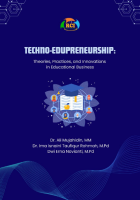
Techno-edupreneurship: Theories, Practices, And Innovations In Educational Business
Synopsis
SPESIFIKASI BUKU
Harga : Rp 105.000
Ukuran : 14,8 cm x 21 cm
Jumlah Halaman : 247 hal
Ketebalan Buku : 1 cm
ISBN : On Proses
Deskripsi Buku : The rapid advancement of digital technology has transformed the landscape of education and business alike. In the past decade, the boundaries between classrooms, industries, and digital platforms have blurred, creating new opportunities for innovation, collaboration, and entrepreneurship. Within this context, the concept of TechnoEdupreneurship emerges as a dynamic intersection between technology, education, and entrepreneurship—an area that invites educators, researchers, and innovators to reimagine how education can generate both social and economic value in the digital era. This book, Techno-Edupreneurship: Theories, Practices, and Innovations in Educational Business, aims to provide a comprehensive and scholarly exploration of this emerging field. It integrates theoretical perspectives from education, business management, and technology studies to present a multidimensional understanding of how innovation can be cultivated and sustained in educational enterprises. The chapters within this volume discuss the conceptual foundations of techno-edupreneurship, the technological transformation shaping modern education, and the strategies for developing and managing educational ventures that are both impactful and sustainable. Unlike a conventional textbook that focuses on classroom instruction, this reference book is intended for readers who seek a deeper analytical and theoretical understanding of how technology-driven entrepreneurship functions within educational contexts. It combines literature- based discussion, conceptual frameworks, and real-world case studies to bridge the gap between academic theory and practical innovation. The book is written to serve educators, higher education managers, researchers, policymakers, and students of education and business who aspire to explore the intersection of teaching, innovation, and enterprise. We are deeply grateful to colleagues, mentors, and students who have inspired the ideas contained in this book. Their insights and experiences have enriched my understanding of how technology and education can converge to create meaningful change. It is my hope that this book will not only contribute to academic discourse but also encourage readers to become creative changemakers in their own educational and professional environments.
REFERENSI :
Abeysekera, L., & Dawson, P. (2015). Motivation and cognitive load in the flipped classroom: Definition, rationale, and a call for research. Higher Education Research & Development, 34(1), 1–14.
Adams, R., Jeanrenaud, S., Bessant, J., Denyer, D., & Overy, P. (2016). Sustainability-oriented innovation: A systematic review. International Journal of Management Reviews, 18(2), 180–205. https://doi.org/10.1111/ijmr.12068
Adner, R. (2006). Match your innovation strategy to your innovation ecosystem. Harvard Business Review, 84(4), 98–107.
Agrawal, K., Athey, S., Kanodia, A., & Palikot, E. (2022). Personalized recommendations in EdTech: Evidence from a randomized controlled trial. arXiv. https://doi.org/10.48550/arXiv.2208.13940
Ajzen, I. (1991). The theory of planned behavior. Organizational Behavior and Human Decision Processes, 50(2), 179–211.
Al-Fuqaha, A., Guizani, M., Mohammadi, M., Aledhari, M., & Ayyash, M. (2015). Internet of Things: A survey on enabling technologies, protocols, and applications. IEEE Communications Surveys & Tutorials, 17(4), 2347–2376.
Aljawarneh, S. A. (2020). Reviewing and exploring innovative ubiquitous learning tools in higher education. Journal of Computing in Higher Education, 32(1), 57–73.
Altbach, P. G., & Salmi, J. (Eds.). (2011). The road to academic excellence: The making of world-class research universities. World Bank Publications.
Anderson, T. (2007). The theory and practice of online learning. Athabasca University Press.
ASEAN Secretariat. (2020). ASEAN plan of action on science, technology and innovation (APASTI) 2021–2025. ASEAN.
ASEAN Secretariat. (2021). ASEAN digital masterplan 2025. ASEAN.
ASEAN Secretariat. (2022). ASEAN digital education action plan 2021–2025. ASEAN.
Asian Development Bank. (2024). Tech-inclusive education: Evidence, practices and a road map. https://www.adb.org/sites/default/files/publication/892641/tech-inclusive-education-evidence-practices-road-map.pdf
Asian Development Bank. (2020). Education and skills in Southeast Asia: Building the foundation for future growth. ADB Publications.
Ashton, K. (2009). That “Internet of Things” thing. RFID Journal, 22(7), 97–114.
ASEAN Secretariat. (2021). ASEAN innovation roadmap 2025. ASEAN.
Audretsch, D. B., & Link, A. N. (2019). Sources of knowledge and entrepreneurial behavior. Springer.
Audretsch, D. B., & Thurik, A. R. (2001). What’s new about the new economy? Sources of growth in the managed and entrepreneurial economies. Industrial and Corporate Change, 10(1), 267–315. https://doi.org/10.1093/icc/10.1.267
Austin, J. E., & Seitanidi, M. M. (2012). Collaborative value creation: A review of partnering between nonprofits and businesses: Part 1. Nonprofit and Voluntary Sector Quarterly, 41(5), 726–758.
Avalos, B. (2011). Teacher professional development in teaching and teacher education over ten years. Teaching and Teacher Education, 27(1), 10–20.
Azuma, R. T. (1997). A survey of augmented reality. Presence: Teleoperators and Virtual Environments, 6(4), 355–385.
Bacigalupo, M., Kampylis, P., Punie, Y., & Van den Brande, G. (2016). EntreComp: The entrepreneurship competence framework. Publications Office of the European Union.
Bakar, L. J. A., & Ahmad, H. (2010). Assessing the relationship between firm resources and product innovation performance. Business Process Management Journal, 16(3), 420–435.
Ball, S. J. (2012). Global education inc.: New policy networks and the neo-liberal imaginary. Routledge.
Barney, J. (1991). Firm resources and sustained competitive advantage. Journal of Management, 17(1), 99–120.
Bass, B. M., & Riggio, R. E. (2006). Transformational leadership (2nd ed.). Lawrence Erlbaum Associates.
Bates, A. W., & Sangrà, A. (2011). Managing technology in higher education: Strategies for transforming teaching and learning. Jossey-Bass.
Bates, T. (2015). Teaching in a digital age: Guidelines for designing teaching and learning. Tony Bates Associates Ltd.
Bates, T. (2019). Teaching in a digital age: Guidelines for designing teaching and learning (2nd ed.). Tony Bates Associates.
Bayne, S., Evans, P., Ewins, R., Knox, J., Lamb, J., Macleod, H., & Sinclair, C. (2020). The manifesto for teaching online. MIT Press.
Bhatnagar, R., & Ghosh, S. (2022). Entrepreneurship in educational technology: Opportunities and challenges in developing nations. Journal of Educational Technology Systems, 51(1), 1–23. https://doi.org/10.1177/00472395221105091
BibliU. (2022, June 29). Research study finds BibliU’s digital content platform improves student outcomes [Press release]. BibliU. https://app.bibliu.com/in-the-news/bibliu-digital-content-platform-improves-student-outcomes
Bishop, J. L., & Verleger, M. A. (2013). The flipped classroom: A survey of the research. ASEE National Conference Proceedings, 30(9), 1–18.
Bozkurt, A., & Sharma, R. C. (2020). Emergency remote teaching in a time of global crisis due to the coronavirus pandemic. Asian Journal of Distance Education, 15(1), 1–6.
Bozkurt, A., Jung, I., Xiao, J., Vladimirschi, V., Schuwer, R., & Egorov, G. (2020). A global outlook to the interruption of education due to COVID-19 pandemic: Navigating in a time of uncertainty and crisis. Asian Journal of Distance Education, 15(1), 1–126.
Published
November 3, 2025
Copyright (c) 2025 Perkumpulan Rumah Cemerlang Indonesia
Details about the available publication format: Pratinjau Buku
Pratinjau Buku
Physical Dimensions
Details about the available publication format: Beli Buku
Beli Buku


