
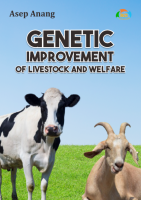
Genetic Improvement Of Livestock And Walfare
Synopsis
SPESIFIKASI BUKU
Harga : Rp 80.000
Ukuran : 18 cm x 25 cm
Jumlah Halaman : 158 hal
Ketebalan Buku : 1 cm
ISBN : 978-634-239-215-7
Deskripsi Buku : The intersection of genetic improvement and animal welfare represents one of the most critical challenges and opportunities in modern livestock production. As the global population continues to grow and the demand for high-quality animal protein increases, the livestock industry faces mounting pressure to enhance productivity while simultaneously ensuring the highest standards of animal welfare. This book addresses the fundamental question that has emerged at the forefront of agricultural science: How can we harness the power of genetics to improve economically important traits without compromising the health, behavior, and quality of life of the animals entrusted to our care? For decades, genetic selection programs have successfully enhanced production traits such as growth rate, milk yield, egg production, and feed efficiency. These achievements have contributed significantly to food security and economic sustainability. However, the single-minded pursuit of production goals has sometimes led to unintended consequences, including increased susceptibility to disease, reproductive problems, lameness, and behavioral abnormalities. The modern paradigm of livestock genetics must therefore evolve to embrace a more holistic approach—one that balances productivity with welfare, sustainability, and ethical responsibility. This volume brings together contributions from leading scientists, veterinarians, ethologists, and industry professionals who have dedicated their careers to understanding the complex relationships between genetics, production, and animal welfare. The chapters within explore both traditional quantitative genetic approaches and cuttingedge genomic technologies, demonstrating how advances in molecular biology, bioinformatics, and breeding methodologies can be applied to improve not only production traits but also welfare-related characteristics such as disease resistance, skeletal integrity, temperament, and adaptability to environmental challenges. | ii The book is organized to provide readers with a comprehensive understanding of the theoretical foundations, practical applications, and ethical considerations inherent in genetic improvement programs. We examine major livestock species including cattle, pigs, poultry, sheep, and aquaculture species, highlighting both the successes achieved and the challenges that remain. Special attention is given to emerging issues such as heat stress tolerance, methane emissions, robustness, and longevity—traits that will become increasingly important as we address climate change and sustainable food production.
REFERENSI :
Akbaş, Y., & Oğuz, İ. (1998). Genetic parameters of egg production traits and egg weight at different ages in Japanese quail. Turkish Journal of Veterinary and Animal Sciences, 22(4), 271–276.
Daikwo, S. I., Momoh, O. M., & Dim, N. I. (2015). Genetic potentials of quail: A review. Journal of Animal Production Research, 27(2), 1–12.
Falconer, D. S., & Mackay, T. F. C. (1996). Introduction to quantitative genetics (4th ed.). Longman Group Ltd.
Kaplan, S., & Gürcan, E. K. (2016). Comparison of growth curves using non-linear regression function in Japanese quail. Journal of Applied Animal Research, 44(1), 112–115.
Kaplan, S., & Gürcan, E. K. (2018). Effect of selection for body weight and egg production on egg quality traits in Japanese quail (Coturnix coturnix japonica) of different lines and relationships between these traits. Kafkas Üniversitesi Veteriner Fakültesi Dergisi, 24(3), 359–364.*
Kaplan, S., Gürcan, E. K., & Gülay, M. Ş. (2016). Genetic parameter estimates for egg quality traits in Japanese quail. Archiv für Geflügelkunde, 80(3), 205–209.*
Kawahara-Miki, R., Sano, S., Nunome, M., Shimmura, T., Kuwayama, T., Takahashi, S., Kawashima, T., Matsuda, Y., Yoshimura, T., & Kono, T. (2013). Next-generation sequencing reveals genomic features in the Japanese quail. Genomics, 101(6), 345–353.*
Kayang, B. B., Fillon, V., Inoue-Murayama, M., Miwa, M., Leroux, S., Feve, K., Monvoisin, J. L., Pitel, F., Vignoles, M., Mouilhayrat, C., Beaumont, C., Ito, S., Minvielle, F., & Vignal, A. (2004). Integrated maps in quail (Coturnix japonica) confirm the high degree of synteny conservation with chicken (Gallus gallus) despite 35 million years of divergence. BMC Genomics, 5(1), 101.*
Lotfi, E., Zerehdaran, S., & Rahimi, G. (2011). Genetic evaluation of egg production traits in Japanese quail using multi-trait animal models. British Poultry Science, 52(4), 403–408.*
Meuwissen, T. H. E., Hayes, B. J., & Goddard, M. E. (2001). Prediction of total genetic value using genome-wide dense marker maps. Genetics, 157(4), 1819–1829.*
Minvielle, F. (2004). The future of Japanese quail for research and production. World’s Poultry Science Journal, 60(4), 500–507.*
Minvielle, F., Kayang, B. B., Inoue-Murayama, M., Miwa, M., Vignal, A., Gourichon, D., Neau, A., Monvoisin, J. L., & Ito, S. (2005). Microsatellite mapping of QTL affecting growth, feed consumption, egg production, tonic immobility and body temperature of Japanese quail. BMC Genomics, 6(1), 87.*
Minvielle, F., Monvoisin, J. L., Costa, J., & Maeda, Y. (2000). Long-term egg production and heterosis in quail lines after within-line or reciprocal recurrent selection for high early egg production. British Poultry Science, 41(3), 335–340.*
Narinç, D., Karaman, E., Aksoy, T., & Fiğlioglu, Ş. (2014). Genetic parameter estimates of growth curve and reproduction traits in Japanese quail. Poultry Science, 93(1), 24–30.*
Nestor, K. E., Anderson, J. W., & Patterson, R. A. (1996). Genetics of growth and reproduction in the turkey. 10. Effect of selection for increased body weight alone or in combination with increased egg production on age at sexual maturity. Poultry Science, 75(8), 1080–1084.*
Nestor, K. E., Anderson, J. W., Patterson, R. A., & Velleman, S. G. (2003). Genetics of growth and reproduction in the turkey. 15. Effects of long-term selection for increased sixteen-week body weight on growth and meat yield. Poultry Science, 82(9), 1389–1397.*
Reddish, J. M., & Nestor, K. E. (2016). Selection for fertility: Direct and correlated responses to selection for fertility in Japanese quail. Poultry Science, 95(2), 289–296.*
Saatci, M., Omed, H., & Ap Dewi, I. (2006). Genetic parameters from univariate and bivariate analyses of egg and weight traits in Japanese quail. Poultry Science, 85(2), 185–190.*
Sari, M., Işik, S., Önk, K., Tilki, M., & Kirmizibayrak, T. (2016). Effects of inbreeding on reproductive traits in Japanese quail. Bulgarian Journal of Agricultural Science, 22(2), 227–231.*
Sezer, M., Berberoğlu, E., & Yıldırım, A. (2006). Genetic parameters estimated for egg laying traits in Japanese quail. Archiv für Geflügelkunde, 70(2), 65–68.*
Published
October 27, 2025
Copyright (c) 2025 Perkumpulan Rumah Cemerlang Indonesia
Details about the available publication format: Pratinjau Buku
Pratinjau Buku
Physical Dimensions
Details about the available publication format: Beli Buku
Beli Buku


