
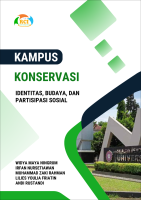
Kampus Konservasi Identitas, Budaya, Dan Partisipasi Sosial
Synopsis
SPESIFIKASI BUKU
◉ Harga : Rp 85.000
◉ Ukuran : 14,8 x 21 cm
◉ Jumlah Halaman : 163 hal
◉ Ketebalan Buku : 1 cm
◉ ISBN : On Proses
◉ Deskripsi Buku : Buku ini lahir dari keyakinan bahwa kampus bukan hanya tempat belajar ilmu pengetahuan, melainkan juga ruang untuk menumbuhkan kepedulian terhadap alam, budaya, dan masyarakat. Konservasi di sini dimaknai secara luas, mencakup upaya menjaga lingkungan, merawat tradisi, serta memperkuat identitas yang membentuk karakter bangsa. Melalui narasi yang mengalir, pembaca diajak menelusuri berbagai bentuk partisipasi sosial dan kearifan lokal yang hidup di sekitar kampus konservasi. Nilai-nilai tersebut menunjukkan bahwa budaya dan alam bukanlah dua hal yang terpisah, melainkan saling melengkapi dan memperkaya kehidupan manusia. Harapannya, buku ini dapat menjadi inspirasi sekaligus penggerak, agar semakin banyak pihak yang terlibat dalam menjaga keberlanjutan lingkungan dan budaya. Dengan semangat kebersamaan, kita semua dapat menjadi bagian dari gerakan konservasi yang bukan hanya menyelamatkan bumi, tetapi juga mewariskan jati diri bangsa kepada generasi mendatang.
References
Aberšek, B., & Flogie, A. (2022). Human awareness, energy and environmental attitudes. Springer International Publishing. https://doi.org/10.1007/978-3-031-05871-4
Aggata, V. (2021). Nilai kearifan lingkungan pada tradisi masyarakat dalam pengelolaan Hutan Bukit Penyabung di Desa Pelangas. Jurnal Sosial dan Sains (SOSAINS), 1(2), 121–129. https://doi.org/10.59188/jurnalsosains.v1i2.32
Agrawal, A., & Gibson, C. C. (1999). Enchantment and disenchantment: The role of community in natural resource conservation. World Development, 27(4), 629–649. https://doi.org/10.1016/S0305-750X(98)00161-2
Ahsani, E. L. F., Pertiwi, R. P., Dewi, K., & Yuliyanti, N. (2024). Literasi sains inklusif berbasis kearifan lokal. Cahya Ghani Recovery.
Al Fawareh, A. J., Dakamsih, N. J., & Alkouri, A. M. (2023). Ecocriticism in modern English literature. Theory and Practice in Language Studies, 13(3), 783–788. https://doi.org/10.17507/tpls.1303.28
Alhazmi, A. A., & Kaufmann, A. (2022). Phenomenological qualitative methods applied to the analysis of cross-cultural experience in novel educational social contexts. Frontiers in Psychology, 13, 785134. https://doi.org/10.3389/fpsyg.2022.785134
Annisa, W., & Endang, W. (2022). Pengelolaan sumber daya air berbasis kearifan lokal sebagai modal untuk pembangunan berkelanjutan. Jurnal Hukum dan Konstitusi, 5(1), 129–144. https://doi.org/10.24090/volksgeist.v5i1.6074
Arnstein, S. R. (1969). A ladder of citizen participation. Journal of the American Institute of Planners, 35(4), 216–224. https://doi.org/10.1080/01944366908977225
Artikel di Nature Reviews Biodiversity mendesak pemikiran ulang perencanaan konservasi. (2025, 31 Maret). Maraujo Lab. https://www.maraujolab.eu/2025/03/31/commentary-in-nature-reviews-biodiversity-urges-rethink-of-conservation-planning
Arts, B., Buizer, M., Horlings, L., Ingram, V., van Oosten, C., & Opdam, P. (2017). Landscape approaches: A state-of-the-art review. Annual Review of Environment and Resources, 42, 439–463. https://doi.org/10.1146/annurev-environ-102016-060932
Pratiwi, S. A. A. (2020). Perilaku kehamilan, persalinan, dan nifas terkait dengan budaya kesehatan pada masyarakat Jawa di wilayah Kabupaten Sukoharjo [Tesis, Universitas Sebelas Maret].
Aryanta, I. W. R., & Redi, W. (2019). Manfaat jahe untuk kesehatan. Widya Kesehatan, 1(2), 39–43.
Asmara, G., Abdullah, I., Abdullah, H. L. M., & Putro, W. D. (2018). Pemberdayaan lembaga adat dalam pengelolaan sumber daya alam pesisir di Desa Mertak, Kecamatan Pujut, Kabupaten Lombok. Prosiding PKM, 1, 1881. https://prosidingpkmcsr.org/index.php/pkmcsr/article/download/264/210
Astuti, A., Aryani, R., Fitri, R. D., Amalina, N., Mardiah, A., Aji, S. P., & Rahmawati, R. S. N. (2022). Kebidanan komunitas. Get Press.
Berkes, F., Colding, J., & Folke, C. (2000). Rediscovery of traditional ecological knowledge as adaptive management. Ecological Applications, 10(5), 1251–1262. https://doi.org/10.1890/1051-0761(2000)010[1251:ROTEKA]2.0.CO;2
Bexell, M., & Jönsson, K. (2017). Responsibility and the United Nations’ sustainable development goals. Forum for Development Studies, 44(1), 13–29. https://doi.org/10.1080/08039410.2016.1252424
Blackburn, A., Jones, L., Morton, V. H., Morris, R. K., Yates, D., & Delicate, A. (2025). Exploring women’s, birth partners’, and healthcare professionals’ views and experiences of childbirth-related perineal trauma care provision in high-income countries: A qualitative systematic review and thematic synthesis. Women and Birth, 38(3), 101907.
Brown, M. B., Morrison, J. C., Schulz, T. T., Cross, M. S., Püschel-Hoeneisen, N., Suresh, V., & Eguren, A. (2022). Using the conservation standards framework to address the effects of climate change on biodiversity and ecosystem services. Climate, 10(2), 13. https://doi.org/10.3390/cli10020013
Brusseau, M. L. (2019). Sustainable development and other solutions to pollution and global change. Dalam Environmental and Pollution Science (pp. 565–574). https://doi.org/10.1016/B978-0-12-814719-1.00032-X
Bučas, J. (2006). Problem of green cultural heritage. Journal of Architecture and Urbanism, 30(1), 15–22. https://doi.org/10.3846/13921630.2006.10697058
Carlsson, L. (2005). Co-management: Concept and methodological implication. Journal of Environmental Management, 75(1), 65–76. https://doi.org/10.1016/j.jenvman.2004.11.008
Çetiner, B., & Yenilmez, M. I. (2021). The role of culture in environmental sustainability. Present Environment and Sustainable Development, 15(2), 259–272. https://doi.org/10.15551/pesd2021152021
Chambers, R. (1994). Participatory rural appraisal (PRA): Challenges, potentials, and paradigm. World Development, 22(10), 1437–1454. https://doi.org/10.1016/0305-750X(94)90030-2
Chau, C. K., Tse, M. S., & Chung, K. Y. (2010). A choice experiment to estimate the effect of green experience on preferences and willingness-to-pay for green building attributes. Building and Environment, 45(11), 2553–2561. https://doi.org/10.1016/j.buildenv.2010.05.017
Chen, Y., & Hu, W. (2022). A critical visual analysis of Chinese and Chinese American representations in picturebooks. International Literacy, 52(17), 79–91. https://doi.org/10.52917/ivlatbsr.2022.016
CMP. (2013). Open standards for the practice of conservation (Version 3). The Conservation Measures Partnership.
Csillik, É. (2021). Intercultural challenges of teaching in multilingual/multicultural classrooms. In Research anthology on bilingual and multilingual education (pp. 481–499). IGI Global. https://doi.org/10.4018/978-1-6684-3690-5.ch025
Cubbage, F. (2004). Natural resource leadership and management: A practical guide for professionals. Routledge. https://www.routledge.com/Natural-Resource-Leadership-and-Management-A-Practical-Guide-for-Professionals/Cubbage/p/book/9780367693008
Dade, A., & Hassenzahl, D. M. (2013). Communicating sustainability: A content analysis of website communications in the United States. International Journal of Sustainability in Higher Education, 14(3), 208–218. https://doi.org/10.1108/IJSHE-08-2011-0053
Dietz, T., Ostrom, E., & Stern, P. C. (2003). The struggle to govern the commons. Science, 302(5652), 1907–1912. https://doi.org/10.1126/science.1091015
Published
September 27, 2025
Copyright (c) 2025 Perkumpulan Rumah Cemerlang Indonesia
Details about the available publication format: Pratinjau Buku
Pratinjau Buku
Physical Dimensions
Details about the available publication format: Beli Buku
Beli Buku


